![Understanding Bloom's Taxonomy – Reading and Writing Successfully in College: A Guide for Students [Revised Edition]](https://rotel.pressbooks.pub/app/uploads/sites/19/2022/07/RevisedBloomsHandout-ModelOnly.jpg)
Bloom’s taxonomy is still a relevant reference for curriculum design and teacher education in the 21st century? Let us take a look at it
Original taxonomy in brief
Bloom’s taxonomy was first published in 1956 as Taxonomy of Educational Objectives, proposing a framework for classifying educational goals in three domains: cognitive, affective and psychomotor.
In the cognitive domain, Bloom and colleagues organized objectives into six hierarchical levels—Knowledge, Comprehension, Application, Analysis, Synthesis and Evaluation—intended to move from simple recall to increasingly complex forms of thinking.
This hierarchy quickly became a shared language for writing objectives, structuring curricula and designing assessments, especially in school and university contexts.
Anderson & Krathwohl’s 2001 revision
Around the late 1990s, Lorin Anderson (a former student of Bloom) and David Krathwohl led a team that revised the taxonomy to respond to developments in cognitive psychology, pedagogy and assessment.
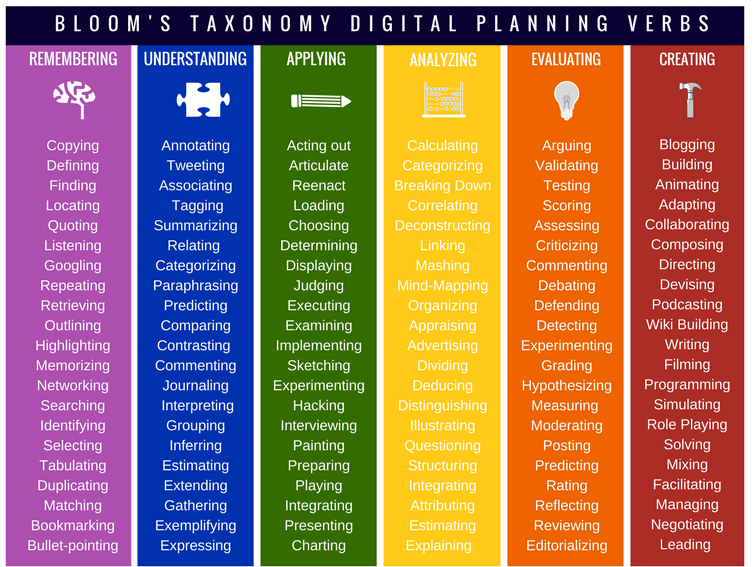
The revised cognitive domain keeps six levels but renames them as verbs—Remember, Understand, Apply, Analyze, Evaluate and Create—emphasizing mental processes and moving Create above Evaluate as the most complex level.
A second “knowledge” dimension was added, distinguishing four types of knowledge (factual, conceptual, procedural and metacognitive), so objectives are now located in a two‑dimensional grid rather than a single ladder.
This shift foregrounds metacognitive knowledge—awareness of one’s own learning strategies—as content that can itself be taught and assessed, which is especially relevant for contemporary approaches to self‑regulated learning.

How it is used in the 21st century
Despite criticisms, both the original and revised versions remain among the most cited and operationalized frameworks in teacher education and curriculum design.
Teaching centres and instructor‑education programs use the revised taxonomy to articulate learning outcomes, align activities and assessments, and scaffold “higher‑order” thinking across the cognitive domain.
Typical 21st‑century uses include mapping verbs like analyze, evaluate and create onto project‑based tasks, inquiry activities and performance assessments, often using the taxonomy table (cognitive process × knowledge type) to check for gaps in a unit or course.
At the same time, many contemporary authors explicitly treat Bloom not as a strict staircase but as a flexible planning tool, acknowledging that learners move fluidly among levels rather than climbing them in linear order.
For example, Krathwohl emphasizes using the taxonomy table pragmatically to classify objectives and align teaching and assessment, rather than as a psychological model of how thinking actually unfolds.
Critiques and limitations
Criticism of Bloom’s taxonomy has intensified in recent decades, especially as new learning theories, constructivist paradigms and neuroscience‑informed views of cognition have emerged.
Scholars point out that the hierarchical structure can oversimplify thinking, implying that some cognitive processes are inherently “higher” or more valuable, even though real learning often involves overlapping, recursive processes.
Several reviews argue that Bloom’s levels are “atheoretical”: they were not derived from robust empirical research on cognition, and distinctions between categories (e.g., analysis vs. evaluation) are often ambiguous in practice.
There is also longstanding concern that educators classify the same objective at different levels, making consistent application across designers and contexts nearly impossible.
Critics highlight that Bloom focuses primarily on the cognitive domain and does not adequately integrate affective, psychomotor or broader developmental aspects of learning, despite claiming three domains.
More recent analyses note cultural and contextual biases: the taxonomy presupposes certain Western, individual‑cognitive notions of learning and may misfit contexts that emphasize communal, embodied or spiritual dimensions.
21st‑century skills and digital literacy
A key contemporary critique is that even the revised taxonomy does not fully address competencies now considered crucial for success in the 21st century, such as digital literacy, collaboration and complex, real‑world problem‑solving.
Because the framework privileges classification of cognitive processes, it struggles to capture networked, multimodal, collaborative practices at the heart of digital communication and knowledge production.
Authors argue that the rigid categories and hierarchical emphasis can constrain teachers’ creativity and flexibility in designing curricula and assessments tailored to diverse learners and interdisciplinary knowledge.
In video‑based critical reviews, educators working with “digital natives” question Bloom’s relevance for contemporary technology‑rich classrooms, noting that newer understandings of learning and neuroscience contradict its hierarchical assumptions. They contend that problem‑solving, design thinking and innovation in volatile, uncertain, complex and ambiguous (VUCA) contexts do not unfold in neat steps from remembering to creating, making Bloom an unreliable guide to actual learning processes.
Bloom in the AI and GPT era
The rise of generative AI has prompted explicit calls to rethink Bloom’s framework for an “AI age.”
One recent commentary argues that the traditional progression from lower‑order to higher‑order skills does not align with how learners interact with AI tools, which allow them to move fluidly among creating, evaluating and refining artifacts through iterative dialogue.
Another analysis claims Bloom’s taxonomy is becoming obsolete for AI‑mediated learning because its static, hierarchical levels cannot capture dynamic, personalized, real‑time learning processes enabled by GPT‑based systems.
These authors suggest that educational leaders consider alternative or complementary frameworks—such as the SOLO taxonomy or “digital taxonomies”—that better represent complex, emergent skills and AI‑supported learning trajectories.
They call for “AI‑compatible” assessment methods that recognize new forms of collaboration between human and machine, and the need for continuous, adaptive measures rather than fixed tiers of cognitive demand.
Contemporary stance: revision, not simple replacement
Even within critical discourse, many scholars and teaching centres position the Anderson & Krathwohl revision as a partial modernization rather than a final solution.
The two‑dimensional model, with metacognitive knowledge explicitly included, is seen as more aligned with contemporary emphases on self‑regulated learning, strategy awareness and reflective practice, but not sufficient to cover all 21st‑century competencies.
Accordingly, Bloom’s taxonomy today tends to be treated as one planning and communication tool among several, valuable for structuring cognitive goals but in need of supplementation by frameworks addressing digital, collaborative, affective and ethical dimensions of literacy and learning.
For an academic educator designing curricula in the 21st century, this means Bloom can still be useful for articulating cognitive outcomes and aligning activities and assessments, especially through the revised verbs and knowledge types, provided it is critically interrogated and embedded within broader, more socio‑technical conceptions of literacy and learning.
Here is a reference list with the main sources (and links) used here.
Foundational descriptions and revisions
-
Bloom, B. S. et al. Bloom’s Taxonomy (overview entry).
-
Wikipedia: <https://en.wikipedia.org/wiki/Bloom%27s_taxonomy>[en.wikipedia]
-
-
Anderson, L. W., & Krathwohl, D. R. (2001). A Revision of Bloom’s Taxonomy of Educational Objectives.
-
Overview article (Krathwohl, 2002, PDF): <https://cmapspublic2.ihmc.us/rid=1Q2PTM7HL-26LTFBX-9YN8/Krathwohl%202002.pdf>[cmapspublic2.ihmc]
-
Anderson & Krathwohl revised taxonomy chart (PDF): <https://quincycollege.edu/wp-content/uploads/Anderson-and-Krathwohl_Revised-Blooms-Taxonomy.pdf>[quincycollege]
-
-
Centre for Teaching Excellence, University of Waterloo. Bloom’s Taxonomy.
-
Teaching tip sheet: <https://uwaterloo.ca/centre-for-teaching-excellence/catalogs/tip-sheets/blooms-taxonomy>[uwaterloo]
-
-
Open Textbooks Hong Kong. Bloom’s Taxonomy revised.
-
Short explanation of the revision: <https://www.opentextbooks.org.hk/ditatopic/6419>[opentextbooks.org]
-
-
Structural Learning. Anderson and Krathwohl’s Revised Taxonomy: A Teacher’s Guide.
-
Contemporary teacher‑oriented guide: <https://www.structural-learning.com/post/anderson-and-krathwohl>[structural-learning]
-
Review and critical appraisal
-
A Review of Revised Bloom’s Taxonomy of Educational Objectives.
-
Nepal Journal of Educational Research (PDF download): <https://www.nepjol.info/index.php/erj/article/download/82852/63319/237540>[nepjol]
-
-
A Critical Appraisal of Bloom’s Taxonomy.
-
American Research Journal of English and Literature (PDF): <https://www.arjonline.org/papers/arjel/v2-i1/14.pdf>[arjonline]
-
-
Criticism on Bloom’s Taxonomy of Educational Objectives.
-
East China Normal University Journal (English abstract and article): <https://xbjk.ecnu.edu.cn/EN/10.16382/j.cnki.1000-5560.2019.02.008>[xbjk.ecnu.edu]
-
Practice‑oriented and comparison resources
-
Bloom’s Taxonomy, Revised for 21st‑Century Learners.
-
Utah CTE handout (PDF): <https://cte.utah.edu/instructor-education/pdfs/bloom-handout.pdf>[cte.utah]
-
-
Revised Bloom’s Taxonomy – University of Delaware.
-
Teaching resource page: <http://www1.udel.edu/educ/gottfredson/451/revisedbloom.html>[www1.udel]
-
-
Bloom’s vs. Anderson & Krathwohl’s taxonomy (comparison).
-
Slideshare presentation: <https://pt.slideshare.net/slideshow/blooms-taxonomy-vs-anderson-krathwohls-taxonomy/242533611>[pt.slideshare]
-
-
Anderson and Krathwohl – Revised Bloom’s Taxonomy (side‑by‑side explanation).
-
Scribd document: <https://www.scribd.com/document/669168750/Anderson-and-Krathwohl-Revised-Blooms-Taxonomy>[scribd]
-
-
Bloom’s Taxonomy original and revised (summary).
-
Scribd summary: <https://www.scribd.com/document/333106712/Blooms>[scribd]
-
21st‑century skills, digital natives and relevance
-
Joana Stella Kompa. Why Bloom’s Taxonomy Has Lost Its Relevance in School and College Education?
-
YouTube lecture: <https://www.youtube.com/watch?v=KpsFcp5Or-o>[youtube]
-
-
Times Higher Education. The Trouble with Bloom’s Taxonomy in an Age of AI.
-
Article: <https://www.timeshighereducation.com/campus/trouble-blooms-taxonomy-age-ai>[timeshighereducation]
-
Bloom and the AI / GPT era
-
Education Week. Bloom’s Taxonomy Needs an Update for the AI Age.
-
Opinion article: <https://www.edweek.org/technology/opinion-blooms-taxonomy-needs-an-update-for-the-ai-age/2026/04>[edweek]
-
-
eLearning Industry. Is Bloom’s Taxonomy Doomed? How GPTs Are Exposing the Death of Traditional Learning Metrics.
-
Article: <https://elearningindustry.com/is-blooms-taxonomy-doomed-how-gpts-are-exposing-the-death-of-traditional-learning-metrics>[elearningindustry]
-
-
IJSRIS Journal. Bloom’s Taxonomy Revisited in the Age of Artificial Intelligence (PDF).
-
Article: <https://www.ijsrisjournal.com/index.php/ojsfiles/article/download/516/356/630>[ijsrisjournal]
-
-
Anthology White Paper. Reframing Bloom’s for the Age of AI.
-
White paper (PDF): <https://backstage.anthology.com/sites/default/files/2025-09/ReframingBloomsForTheAgeOfAI_WhitePaper_v1.pdf>[backstage.anthology]
-
-
Sciety / Preprints. Bloom Meets Gen AI: Reconceptualising Bloom’s Taxonomy in the Era of Co‑piloted Learning.
-
Perspective paper: <https://sciety.org/articles/activity/10.20944/preprints202501.0271.v1>[sciety]
-
-
The Citadel. Learning in the Age of AI: Bloom’s Taxonomy Revisited.
-
Teaching resource: <https://www.citadel.edu/ai-education/learning-in-the-age-of-ai-blooms-taxonomy-revisited/>[citadel]
-
-
LinkedIn article. Rethinking Bloom’s Taxonomy in the Age of AI.
-
Commentary: <https://www.linkedin.com/pulse/rethinking-blooms-taxonomy-age-ai-tessie-tess-tan-%E9%99%88%E8%95%8A%E8%95%8A-zvc1c>[linkedin]
-
-
LinkedIn article. Is Bloom’s Taxonomy Dead? Adapting Learning Outcomes for the Age of AI.
-
Commentary: <https://www.linkedin.com/pulse/blooms-taxonomy-dead-adapting-learning-outcomes-age-ai-al-sawafi-vs7xf>[linkedin]
-
-
D2L / Teach & Learn podcast episode with Michelle Kassorla. Reimagining Bloom’s Taxonomy for AI‑Driven Learning.
-
YouTube: <https://www.youtube.com/watch?v=GECOs3_Dgz4>[youtube]
-
-
Rethinking Bloom’s Taxonomy for the AI Era – Higher‑order thinking talk.
-
YouTube: <https://www.youtube.com/watch?v=XPWcz4-g9KU>[youtube]
-