Prezados alunos e alunas,
Tudo bem?
Eu sou o Professor Marcello de Oliveira Pinto. Estarei com vocês aqui nesta disciplina. Nesta apresentação, vou descrever um pouco o curso que você está iniciando e o que você lê aqui reverbera o que já comentamos em sala.
Organização
A disciplina será ministrada de acordo com o calendário da faculdade. Ao longo dos semestres, faremos os ajustes necessários para que o curso possa se adaptar ao seu contexto.
Recursos didáticos
o material do curso está aqui
Está é a ementa do curso
por aqui focaremos em Discurso: Coesão e textualidade.
Avaliação
Vocês serão avaliados da seguinte forma: Duas notas comporão sua média final (MF).
A primeira (N1) será composta pela soma das (auto)avaliações que vocês farão ao longo do curso, totalizando 10 pontos .
A segunda (N2) será composta por uma avaliação holística da sua performance em sala feita por mim, totalizando também 10 pontos.
A média final será a soma das duas notas e para aprovação imediata é preciso que essa média seja igual ou maior que 7 pontos.
Importante: somente os alunos devidamente inscritos podem participar da disciplina. Caso você não esteja inscrito, por gentileza procurar a secretaria do seu curso. O docente não inclui ou faz a inscrição do aluno na turma.
Qualquer dúvida sobre as médias para aprovação, prova final, o que é o CR, calendário acadêmico e demais regulamentos, visitem o site da UERJ
Bom trabalho!
Aula 1
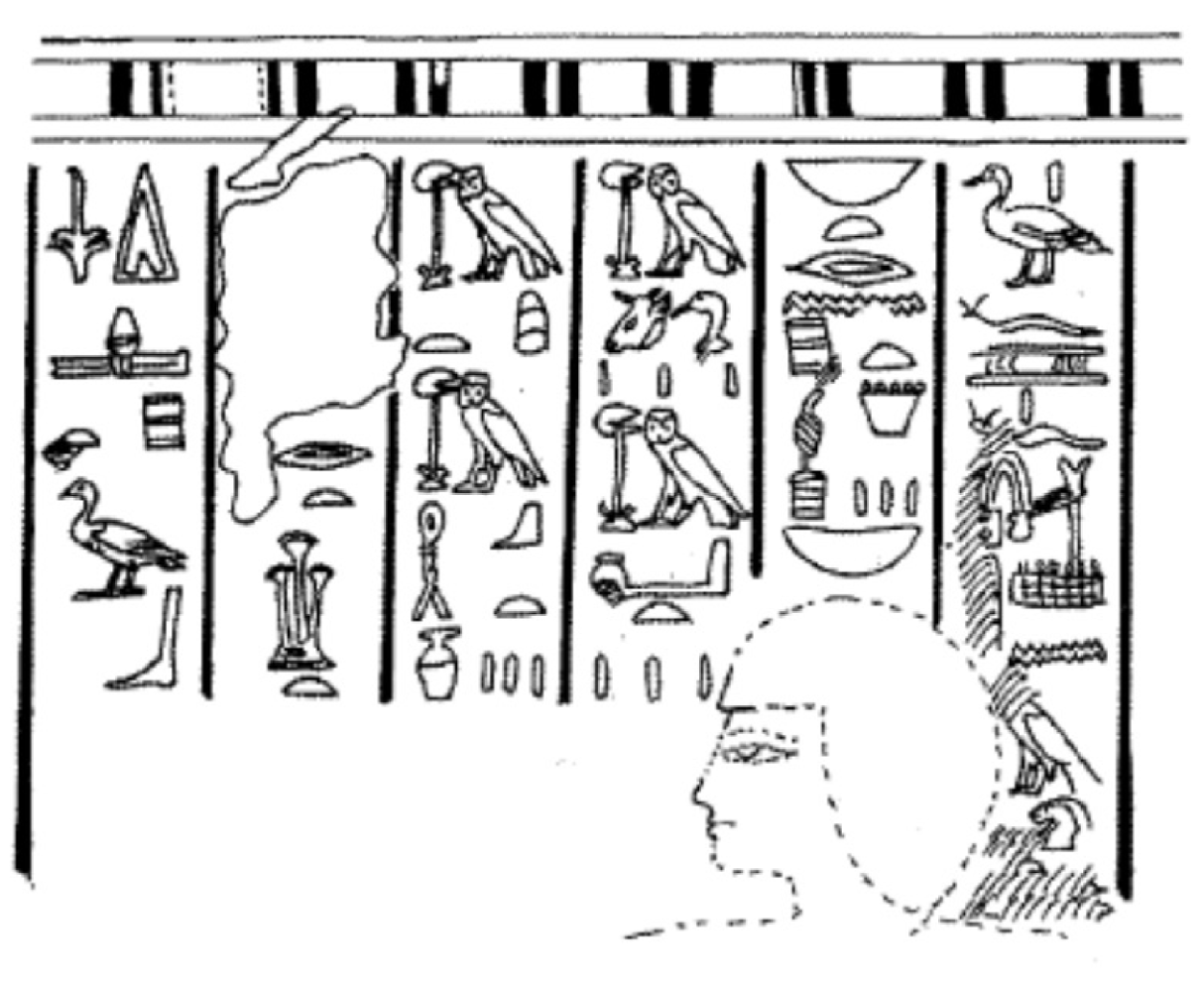
Images 2
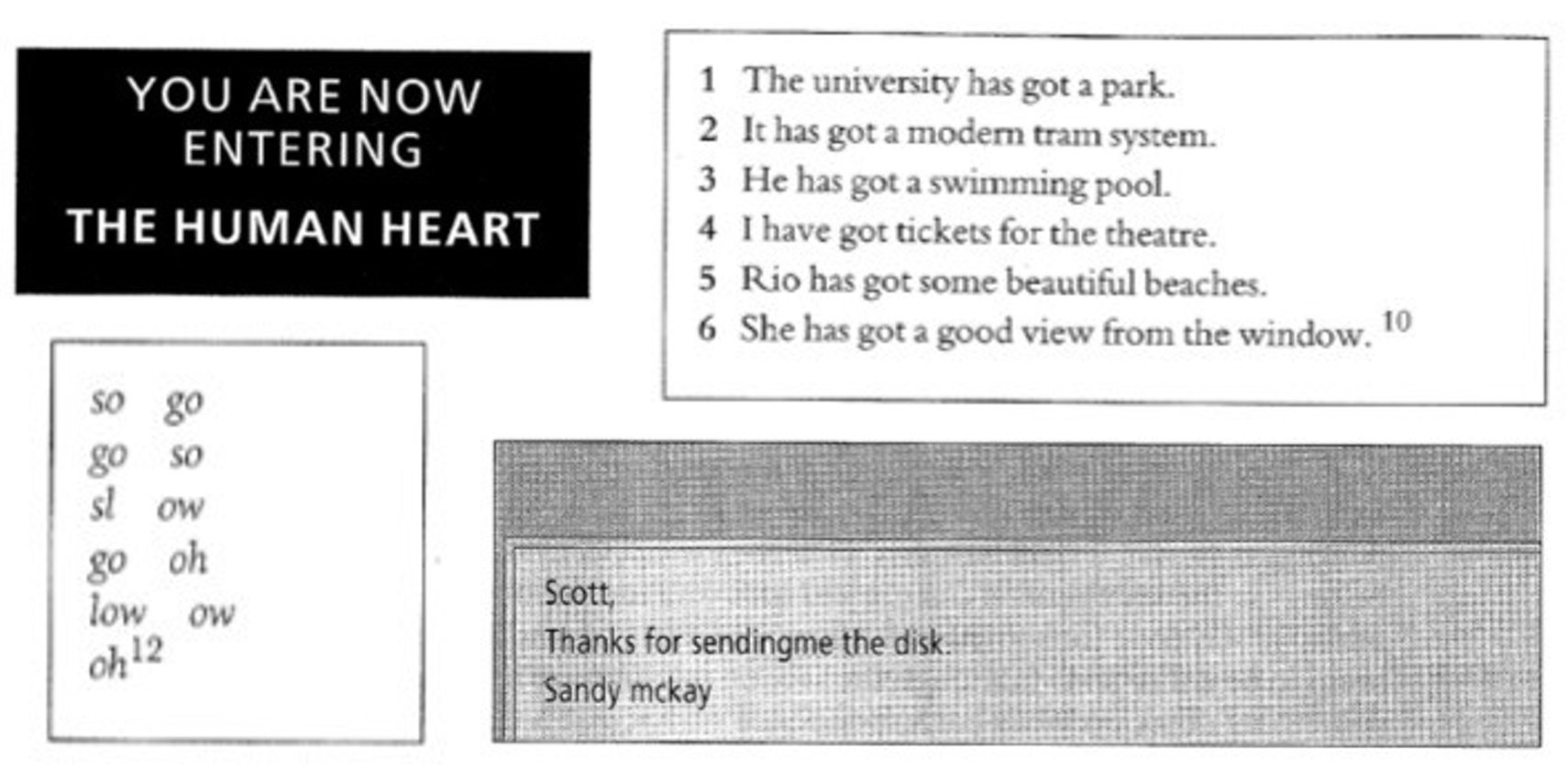
images 3
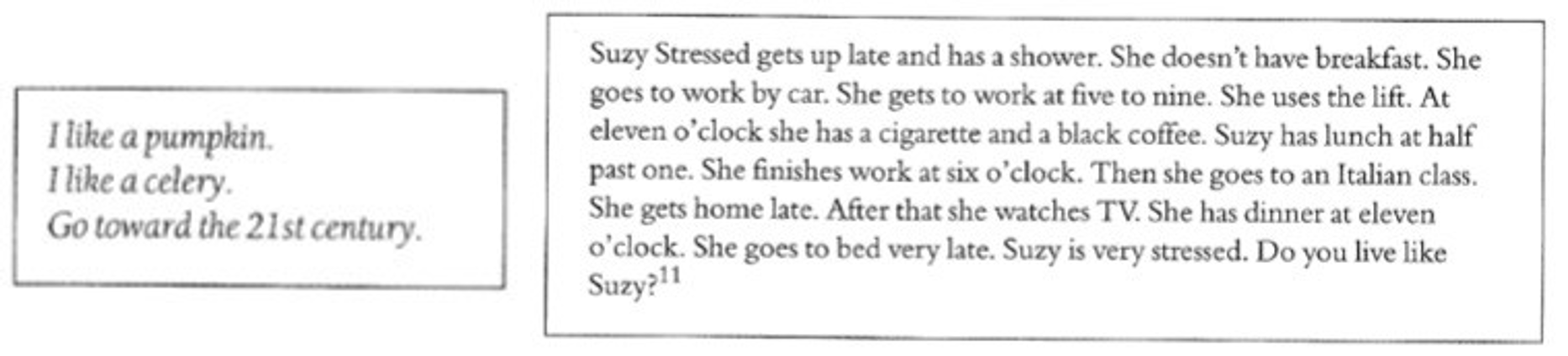
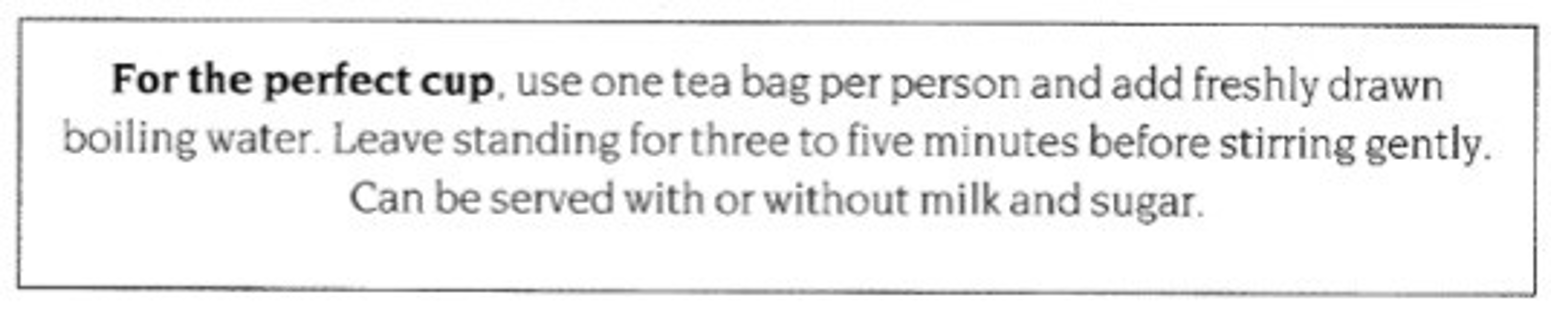
“This is what language does: organize the world into manageable, and in some sense artificial, units that can then be inhabited and manipulated.”
Stanley Fish
To go further: Is there a text in this class? : the authority of interpretive communities by Stanley Fish
Aula 2
Language Is the First Weapon Drawn” — Discourse, Relativity, and Meaning
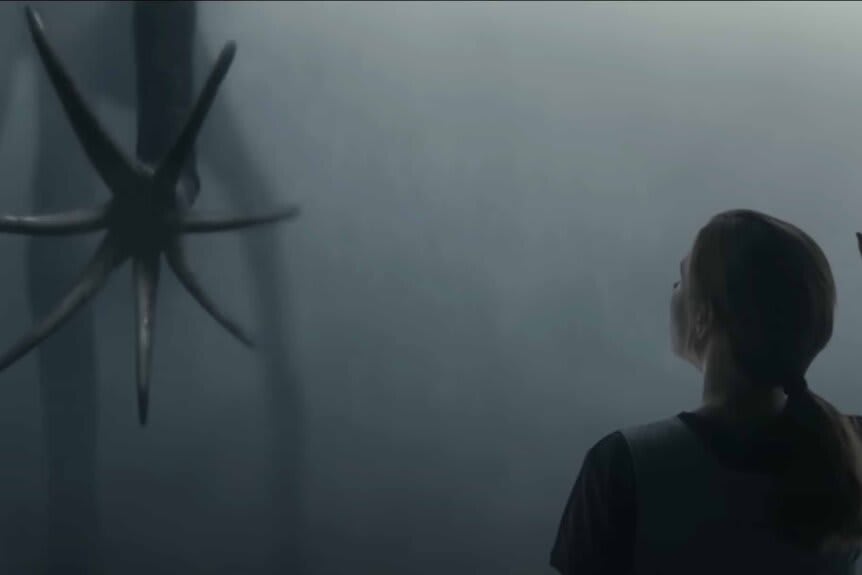
“I used to think this was the beginning of your story. Memory is a strange thing. It doesn’t work like I thought it did. We are so bound by time, by its order… But now I’m not so sure I believe in beginnings and endings. There are days that define your story beyond your life… like the day they arrived.”
Those above are the first lines of Arrival (2016), directed by Denis Villeneuve, a science fiction film adapted from Ted Chiang’s award-winning novella “Story of Your Life” (1998), with a screenplay by Eric Heisserer. While both works tell the same core story — a linguist recruited to communicate with extraterrestrial visitors — they emphasize different dimensions of the encounter. Chiang’s story grounds the aliens’ cognition in physics, particularly variational principles such as Fermat’s principle of least time, using language to explore determinism and free will. Villeneuve’s film shifts the emphasis toward translation, geopolitics, and the fragility of human communication.
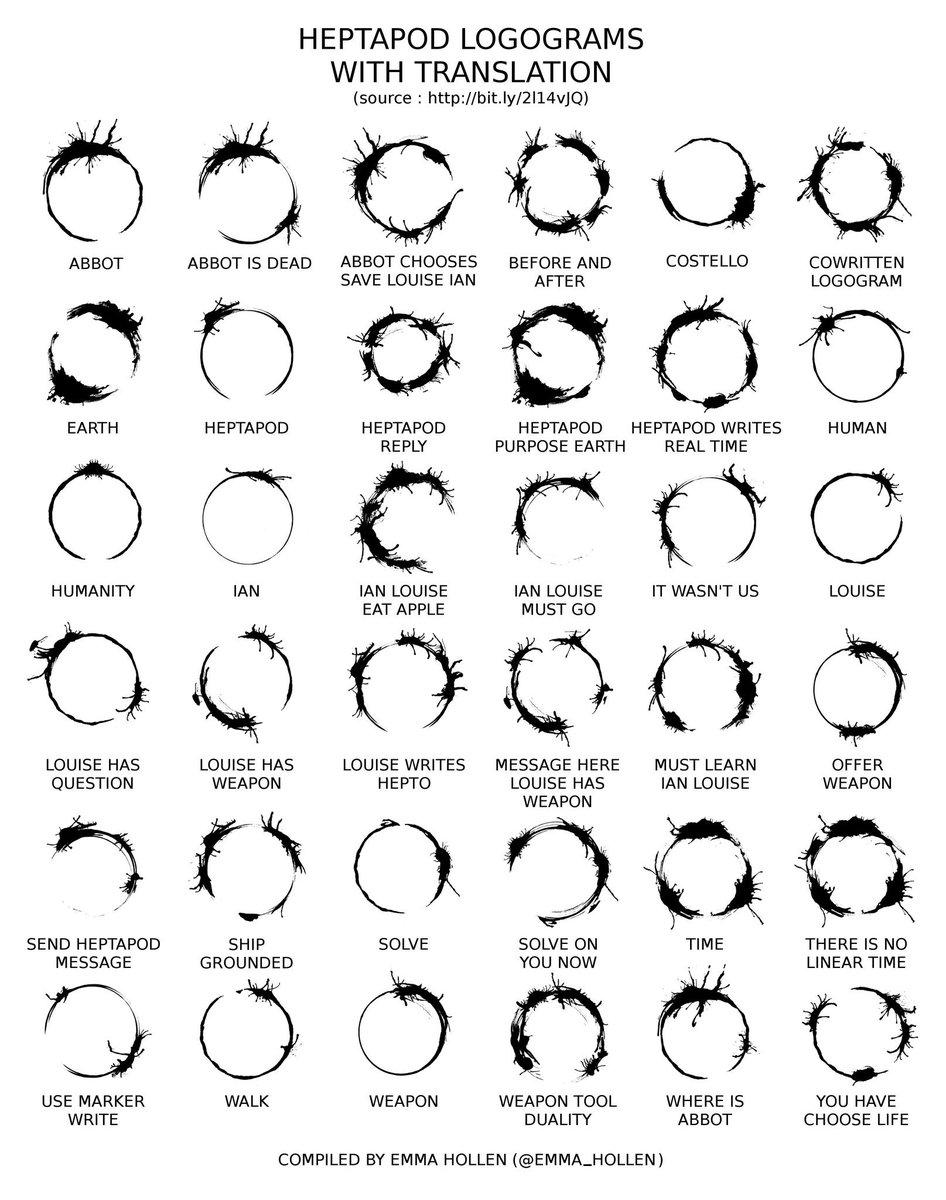
Now take a look at The heptapods’ written language below how do you compare/ contrast it to human written language?
The Plot
Twelve mysterious alien vessels, called “shells,” appear simultaneously at twelve points across the globe. Dr. Louise Banks, a renowned linguist, is recruited by the U.S. military to lead the team tasked with understanding the aliens’ language and answering one urgent question: What is your purpose on Earth?
Working alongside physicist Ian Donnelly, Louise discovers that the heptapods communicate through a complex written system of circular, ink-like logograms — a language with no correlation between its spoken and written forms, and no linear sequence from beginning to end called Heptapod B. The title, and the main theme of our classroom, comes from the film’s central crisis, when the heptapods finally answer the mission’s key question. The logogram they produce is translated as “OFFER WEAPON.”
Almost immediately, all twelve national sites around the world receive similar messages. China interprets the transmission as a threat and prepares a military strike; global communication between the research teams collapses; panic spreads. Louise, however, resists the literal translation. She argues:
“We need to make sure that they understand the difference between a weapon and a tool. Language is messy, and sometimes one can be both.”
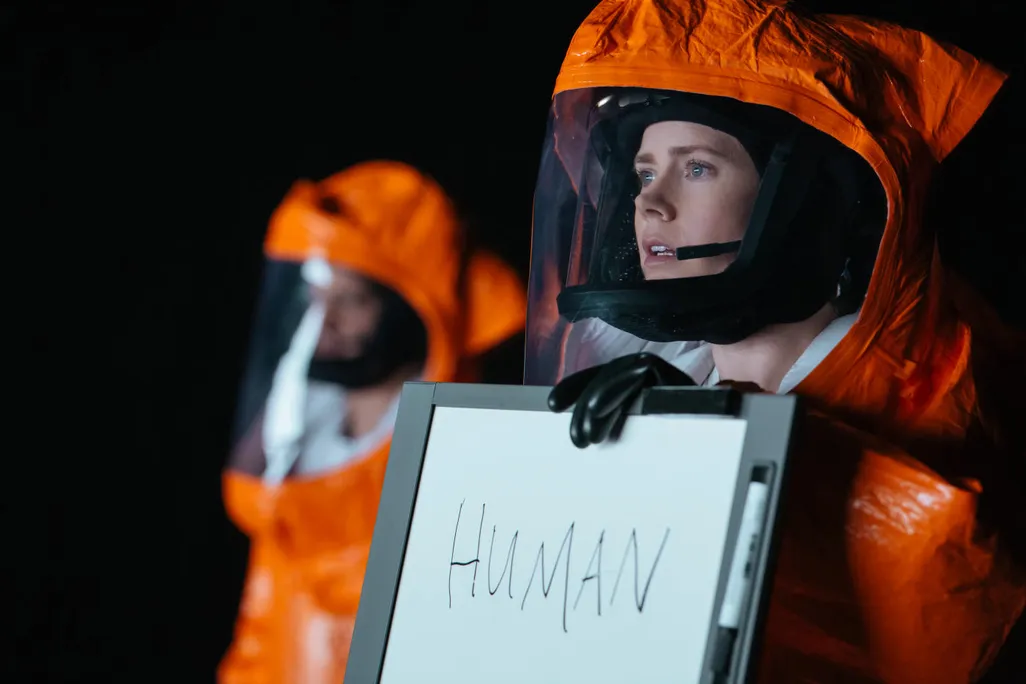
What does she mean? what does Saussure, Bakhtin/Voloshinov and Foucault have to do with it? and what all of this has to do to with our course?
The Sapir-Whorf Hypothesis
The Sapir-Whorf hypothesis, also known as linguistic relativity, proposes that the structure of a language influences how its speakers perceive, think about, and experience the world. Named after linguists Edward Sapir and his student Benjamin Lee Whorf in the early twentieth century, the hypothesis argues that language is not merely a passive tool for expressing thoughts — it actively shapes them.
Two Versions
- Strong version — linguistic determinism: language determines thought. If a language lacks a category or structure, its speakers cannot (or can only with great difficulty) think the corresponding concept.
- Weak version — linguistic relativity: language influences thought. Grammatical and lexical patterns make certain ways of seeing the world more habitual, without imprisoning the mind.
Classic Examples
Whorf’s studies of the Hopi language led him to claim that its speakers conceptualize time differently from English speakers, since Hopi grammar does not organize time as a linear sequence of countable units. Color perception offers another frequently cited case: Russian has separate basic terms for light blue (goluboy) and dark blue (siniy), and experiments suggest Russian speakers discriminate between these shades faster than English speakers, who use a single word.
A frequently quoted passage by Whorf captures the core idea: we cut nature up and organize it into concepts “largely because we are parties to an agreement to organize it in this way — an agreement that holds throughout our speech community and is codified in the patterns of our language”.
Controversy and Relevance
The hypothesis remains debated. Critics point to universal cognitive capacities that transcend linguistic differences, arguing that thought is not hostage to grammar. Supporters, however, note growing experimental evidence that language does bias perception and memory in measurable ways. Either way, the hypothesis has driven decades of research in linguistics, anthropology, and cognitive science
In Arrival
The film adopts the strong version: when Louise Banks learns Heptapod B — a circular, non-linear written language — her brain is “rewired,” and she begins to perceive past, present, and future simultaneously. The film thus turns a contested linguistic theory into narrative form: learning a new language does not just change what Louise can say — it changes what time is for.
And to finish: Is language a weapon, a tool, or the world itself?”
to go further:
The science behind the twisting alien linguistics of Arrival
Does the Linguistic Theory at the Center of the Film ‘Arrival’ Have Any Merit?
the film:
Aula 3
“Memory is a strange thing..” – From Heptapod B to a Sonnet
Is the logogram below cohesive? What visual features create unity?Is it coherent to you as a human viewer? Why or why not? What does this suggest about the relationship between cohesion and coherence? What is cohesion and coherence?

“I used to think this was the beginning of your story. Memory is a strange thing. It doesn’t work like I thought it did. We are so bound by time, by its order… But now I’m not so sure I believe in beginnings and endings. There are days that define your story beyond your life… like the day they arrived.”
Tasks:
- Reference: Circle one example of anaphoric reference (demonstrative or pronoun). What does it refer back to?
- Lexical repetition: Underline repeated lexical items. What chain do they create?
- Conjunction: Box the adversative conjunction. What pivot does it mark?
- Substitution/Ellipsis: Can you find any? If not, why might this genre avoid them?
Genre: Film voiceover / interior monologue
somewhere i have never travelled, gladly beyond
E. E. Cummings 1894 –1962
somewhere i have never travelled, gladly beyond
any experience, your eyes have their silence:
in your most frail gesture are things which enclose me,
or which i cannot touch because they are too near
your slightest look easily will unclose me
though i have closed myself as fingers,
you open always petal by petal myself as Spring opens
(touching skillfully, mysteriously) her first rose
or if your wish be to close me, i and
my life will shut very beautifully, suddenly,
as when the heart of this flower imagines
the snow carefully everywhere descending;
nothing which we are to perceive in this world equals
the power of your intense fragility: whose texture
compels me with the colour of its countries,
rendering death and forever with each breathing
(i do not know what it is about you that closes
and opens; only something in me understands
the voice of your eyes is deeper than all roses)
nobody, not even the rain, has such small hands
News
Twelve alien vessels landed today at twelve global locations. Dr. Louise Banks, a linguist, stated that communication is proceeding. However, military officials remain cautious. The vessels have not responded to radio transmissions. This has increased international tension.
| Genre | Dominant Cohesive Devices | Coherence Expectations |
|---|---|---|
| Lyric poem | Lexical repetition, parallelism, phonological patterning | High tolerance for ambiguity; coherence often deferred or symbolic |
| News report | Conjunction (additive, temporal), reference (pronouns, demonstratives) | Immediate, linear coherence; low ambiguity tolerance |
| Novel (romance) | Lexical chains, substitution, ellipsis | Progressive coherence; reader constructs timeline and causality |
| Academic paper | Conjunction (causal, adversative), lexical reiteration | Explicit, hierarchical coherence; logical progression |
| Heptapod B | Non-linear, simultaneous logograms | No sequential syntax; coherence is immediate and holistic — if accessible at all |
About the end of the class discussion:
Entre-espaço: arquitetura, imagem e experiência
An atelic model for the textual limen
Aula 4
Is it a spoiler?
Have you seen Arrival? have you enjoyed, what was your favorite….oops! stop now, do not say anything else. No spoilers in this classrrom!
What is your personal “statute of limitations” on a spoiler? How many days, weeks, or years must pass before a plot point changes from a protected secret to baseline public knowledge?
Think of the last time someone spoiled a movie or book for you. Was it an accident, or did it feel like a subtle power move? How did your relationship with that speaker affect how angry you got?
Do you ever actively look for spoilers? If yes, why? If no, what is the exact feeling you lose when a twist is revealed prematurely?
Where is the line between a teaser, a trailer, a spoiler, and a leak? What linguistic or contextual features separate these four words?
Look at the word “Spoil.” It literally means to rot, ruin, or decay (like spoiled milk). Why do you think our language uses such a visceral, organic word for a purely cognitive experience?
to ponder about:
                   THE PRAGMATIC BREAKDOWN OF A SPOILER │
                  └─────────────────────────────────────────┘
                                       │
         ┌─────────────────────────────┴─────────────────────────────┐
         ▼                                                           ▼
[ Grice's Maxim of Quantity ]                               [ Epistemic Autonomy ]
Reveals too much information too early,                    Deprives the listener of their right
violating cooperative conversation.                        to generate original inferences.
1. Violating Grice’s Maxims
- Maxim of Quantity: A spoiler provides too much information, breaking the expectation of cooperative dialogue.
- Maxim of Manner: It disrupts the chronological order designed by the author to build suspense.
2. Epistemic Paternalism & Autonomy
Discuss the basic idea of the text The Real Spoilers Puzzle by reading its…
ABSTRACT
Spoilers consist in the revelation of major plot points of fictions prior to the time at which we’re intended to discover them. The small literature on spoilers argues that we dislike them because they have a negative effect on story enjoyment. I argue that our dislike of spoilers is wildly disproportionate to their actual effects on story enjoyment. The real puzzle of spoilers is why we dislike them, given their small and inconsistent effects on story enjoyment. I argue that the dislike of spoilers arises from a desire not to be subject to other agents in how we come to acquire certain kinds of knowledge about fictions.
Do you agree? The anger caused by a spoiler is rarely about the ruined plot; it is an issue of power dynamics. A spoiler is an act of conversational dominance where the speaker deprives the listener of their epistemic autonomy—the freedom to acquire knowledge naturally and form independent interpretations.
Now work in small groups to analyze how different narrative layers handle exposure. Use the structural distinctions outlined in Journal of Consumer Psychology:
- Outcome Spoilers: Revealing what happens (the ending).
- Process Spoilers: Revealing how it happens (the journey).
discuss:
- Why can we reread a complex literary masterpiece dozens of times without it being “spoiled”?
- If a text is completely ruined by knowing its ending, was it actually a good piece of literature, or just a delivery mechanism for a gimmick?
Now look

- Do you agree?
✍️ rewrite a classic spoiler into three distinct linguistic frameworks:
- The Pure Plot Dump (Destructive)
- The Thematic Scaffold (Enhances deep reading without ruining the plot)
- The Clickbait Teaser (Manipulates anticipation)
food for thought
“If a summary contains the exact same plot facts as a spoiler, why does a student thank a classmate for a summary of a reading, but curse a classmate for a spoiler of a movie? Is the anger rooted in the semantic data itself, or is it entirely about the pragmatic context of delivery?”
Read the two texts below. Both summarize the exact same plot points of William Shakespeare’s Macbeth. However, they belong to two entirely different linguistic genres. What are the diferrences? what are the genres?
Text A
Macbeth (1606): A brave Scottish general receives a prophecy from a trio of witches that one day he will become King of Scotland. Consumed by ambition and spurred to action by his wife, Macbeth murders King Duncan and takes the Scottish throne for himself. He is then wracked with guilt and paranoia.
Text B
Macbeth (1606): Macbeth kills the king because some witches told him he would, but his guilt makes him hallucinate. In the final battle, he thinks he is invincible because of a prophecy that no man born of a woman can kill him, but Macduff reveals he was delivered via C-section right before he cuts Macbeth’s head off.

next class we will be talking about summary x spoiler! be ready!
Aula 5
Summaries, Spoilers, and the Ethics of Telling
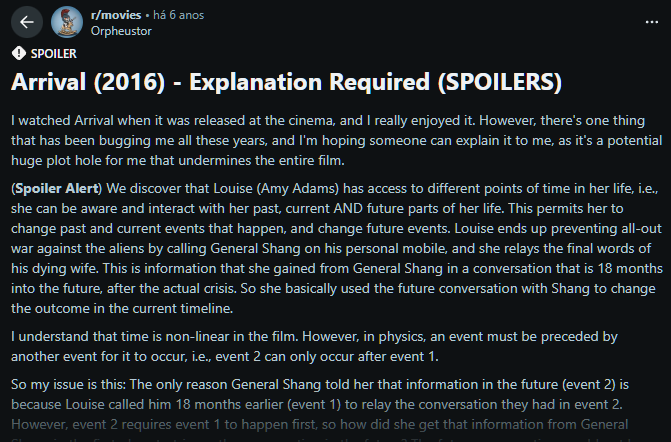
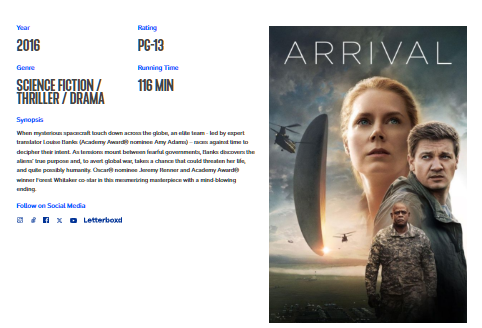
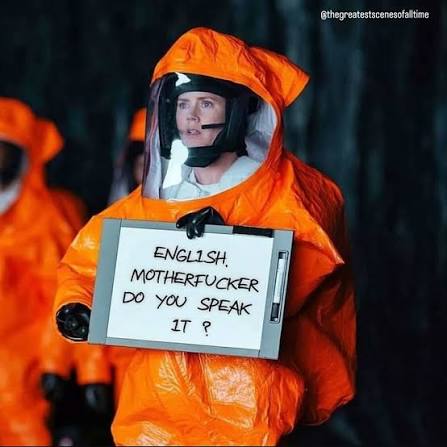
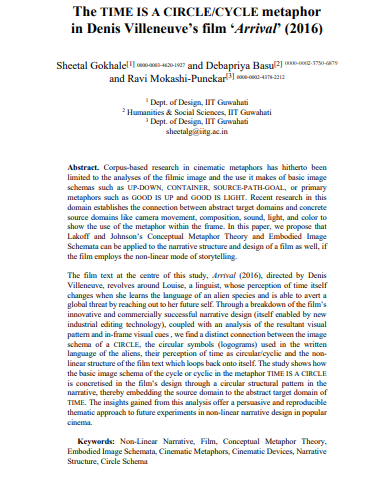
Hello again! All here “tell the story.” of Arrival Which one is a summary? Which one is a spoiler? Are all summaries? Are all spoilers? Who decides?
Concepts – theory focus
| Dimension | Summary | Spoiler |
|---|---|---|
| Content | Macrostructure (gist) | Plot-crucial revelation (often the twist/ending) |
| Consent | Solicited, expected | Unsolicited (or warned) |
| Position | Paratext: back cover, abstract, review | Leaks into conversation, social media, titles |
| Function | Orient, advertise, study | Disrupts suspense; reconfigures first reading |
| Multimodal markers | Neutral layout, “Synopsis” label | “SPOILER ALERT” banners, blurred images, click-to-reveal buttons |
The Empirical Debate
Does being spoiled actually ruin enjoyment? The research is genuinely divided:
- Spoilers don’t spoil: Leavitt and Christenfeld (2011) found that readers preferred spoiled versions of ironic-twist, mystery, and literary short stories — even Agatha Christie mysteries improved when the solution was revealed first. Their explanation: spoilers increase processing fluency, making stories easier to follow and thus more pleasurable.
- Spoilers do spoil: Johnson and Rosenbaum (2015) found spoiled stories were rated less suspenseful, less fun, less moving, and less immersive — arguing the popular belief that spoilers harm enjoyment is “well-founded and not a myth”.
- It depends on mode and timing: spoilers hurt television episodes but not short stories in one 2019 study; spoilers presented before a story reduced enjoyment while mid-story spoilers had no effect; and later replications suggest the original positive effect may be an outlier.
Multimodal Analysis Workshop
work in groups
Group 1 — The Trailer (audiovisual summary)
- What does the trailer select? What does it hide?
- Note: the trailer carefully preserves the Hannah twist — a summary designed around a spoiler. Discuss editing, music, and voiceover as cohesive devices that create a “contract of not-telling.”
Group 2 — The Warning Label (metadiscourse)
- Analyze “SPOILER ALERT” as a speech act. What does it do? (It doesn’t prevent the spoiler — it transfers responsibility to the reader.)
- Compare: Wikipedia’s spoiler policy, Reddit’s spoiler tags, blurred thumbnails on YouTube.
Group 3 — The Meme (spoiler as social currency)
- Show spoiler memes (e.g., famous twist reveals). Discuss: why do people spoil? Research suggests spoilers can trigger psychological reactance — audiences resist being told what they may not know — and that spoiler avoidance functions as self-protection of anticipated emotional experience.
Group 4 — The Academic Abstract (the licensed spoiler)
Compare a film studies abstract about Arrival with the film’s synopsis. The abstract must reveal the argument — in academia, the “spoiler” is the point. What does this reveal about genre contracts?
Talking about genres, what is the genre “summary”?
What a Summary Is and How It Works
1. The Concept
Van Dijk’s foundational insight: a summary is itself a discourse, whereas a macrostructure is the abstract underlying semantic structure of the source discourse. In other words:
- The macrostructure is the text’s gist — its global meaning, built hierarchically from macropropositions.discourses+1
- The summary is the verbalization of one possible macrostructure — which is why two good summaries of the same text are never identical.
2. The Cognitive Operations: Macrorules
Kintsch and van Dijk (1978) proposed that readers reduce a text to its gist through three semantic mapping rules:
| Macrorule | Operation | Example with Arrival |
|---|---|---|
| Deletion | Remove propositions irrelevant to interpreting the rest | Drop: the kangaroo anecdote, the whiteboard scenes, minor characters |
| Generalization | Replace a sequence with a superordinate proposition | “Louise writes words, points, shows objects” → “Louise teaches the aliens human language” |
| Construction | Replace a sequence with a proposition denoting the global event | “Shells appear, nations panic, mistranslation spreads” → “Humanity nearly goes to war over a misunderstood word” |
Brown and Day (1983) expanded these into six operational rules for teaching summarization: (1) delete trivial information, (2) delete redundancy, (3) substitute lists with superordinate terms, (4) substitute action sequences with a “super-act,” (5) select a topic sentence, (6) invent a topic sentence when none exists.
3. The Structure of a Summary
A well-formed summary typically displays:
- Brevity with coverage: only macropropositions, no microstructure detail.
- Autonomy: readable without the source text.
- Fidelity: no information that contradicts or exceeds the source (unlike the spoiler, the summary respects the text’s own hierarchy of importance).
- Genre-appropriate superstructure: abstracts follow situation → problem → method → results; synopses follow setting → protagonist → inciting conflict.
- Metadiscursive framing: “The film tells…”, “The author argues…” — the summary signals its status as a report of another discourse.
Reflexive Debate
Motion: “This house believes that a spoiler is just a summary without consent.”
- Group A — Semanticists: Spoiler and summary differ in content selection (gist vs. twist). A summary of Arrival can exist without revealing Hannah; a spoiler is the revelation.
- Group B — Pragmatists: Identical sentences can be summary or spoiler depending on context, consent, and timing. “Hannah dies” is a spoiler on Twitter, a summary in a scholarly article, and — in the film itself — a flash-forward.
- Group C — Empiricists: The whole debate rests on the assumption that spoilers harm. If spoiled stories are sometimes enjoyed more, perhaps the spoiler’s crime is not informational but social: violating the ritual of first encounter.
Reflexive turn: Arrival asks whether Louise, knowing her daughter will die, is “spoiled.” Her answer — “I embrace it” — aligns strikingly with the processing-fluency findings: knowing the ending can deepen, not diminish, the experience.
Closing Synthesis
Multimodal production task (in pairs): Create two versions of the same Arrival information:
- A back-cover synopsis (licensed summary, no twist) — text only.
- A spoiler post for social media — must include one image, one warning device, and the revelation.
Then swap with another pair and answer: At what exact moment did the summary become a spoiler — the content, the label, the image, or the context?
Exit ticket question: “Is Arrival‘s opening scene a spoiler, a summary, or neither? Defend your answer using one academic reference.”
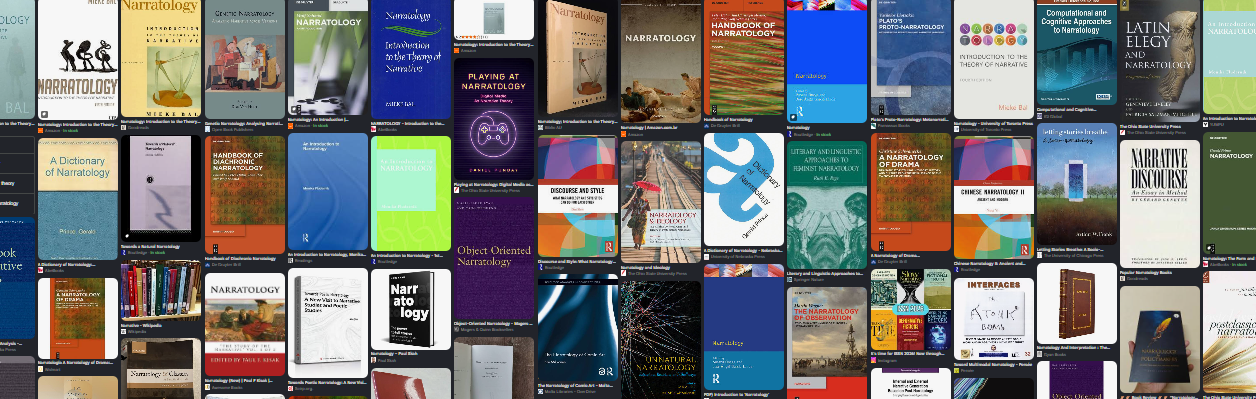
Extra: have you ever head of narratology? How does it connect to this course?
Academic References
- Leavitt, J. D., & Christenfeld, N. J. S. (2011). Story spoilers don’t spoil stories. Psychological Science, 22(9), 1152–1154.journals.sagepub
- Leavitt, J. D., & Christenfeld, N. J. S. (2013). The fluency of spoilers: Why giving away endings improves stories. Scientific Study of Literature, 3(1), 93–104.ssol-journal
- Johnson, B. K., & Rosenbaum, J. E. (2015). Spoiler alert: Consequences of narrative spoilers for dimensions of enjoyment, appreciation, and transportation. Communication Research, 42(8), 1068–1088.journals.sagepub
- Johnson, B. K., et al. (2018). (Don’t) tell me how it ends: Spoilers, enjoyment, and psychological reactance. Media Psychology.tandfonline
- Kintsch, W., & van Dijk, T. A. (1978). Toward a model of text comprehension and production. Psychological Review, 85(5), 363–394.
- Kress, G., & van Leeuwen, T. (2001). Multimodal Discourse: The Modes and Media of Contemporary Communication. Arnold.
- Genette, G. (1997). Paratexts: Thresholds of Interpretation. Cambridge University Press.
Academic References on the concept of summary
- Kintsch, W., & van Dijk, T. A. (1978). Toward a model of text comprehension and production. Psychological Review, 85(5), 363–394.discourses
- van Dijk, T. A. (1980). Macrostructures: An Interdisciplinary Study of Global Structures in Discourse, Interaction, and Cognition. Erlbaum.discourses
- van Dijk, T. A., & Kintsch, W. (1983). Strategies of Discourse Comprehension. Academic Press.discourses
- Brown, A. L., & Day, J. D. (1983). Macrorules for summarizing texts: The development of expertise. Journal of Verbal Learning and Verbal Behavior, 22(1), 1–14.
- Genette, G. (1997). Paratexts: Thresholds of Interpretation. Cambridge University Press.
- Kress, G., & van Leeuwen, T. (2001). Multimodal Discourse: The Modes and Media of Contemporary Communication. Arnold.
Aula 6
“Guess the Genre… or Did I Just Get Catfished by a Sentence?”
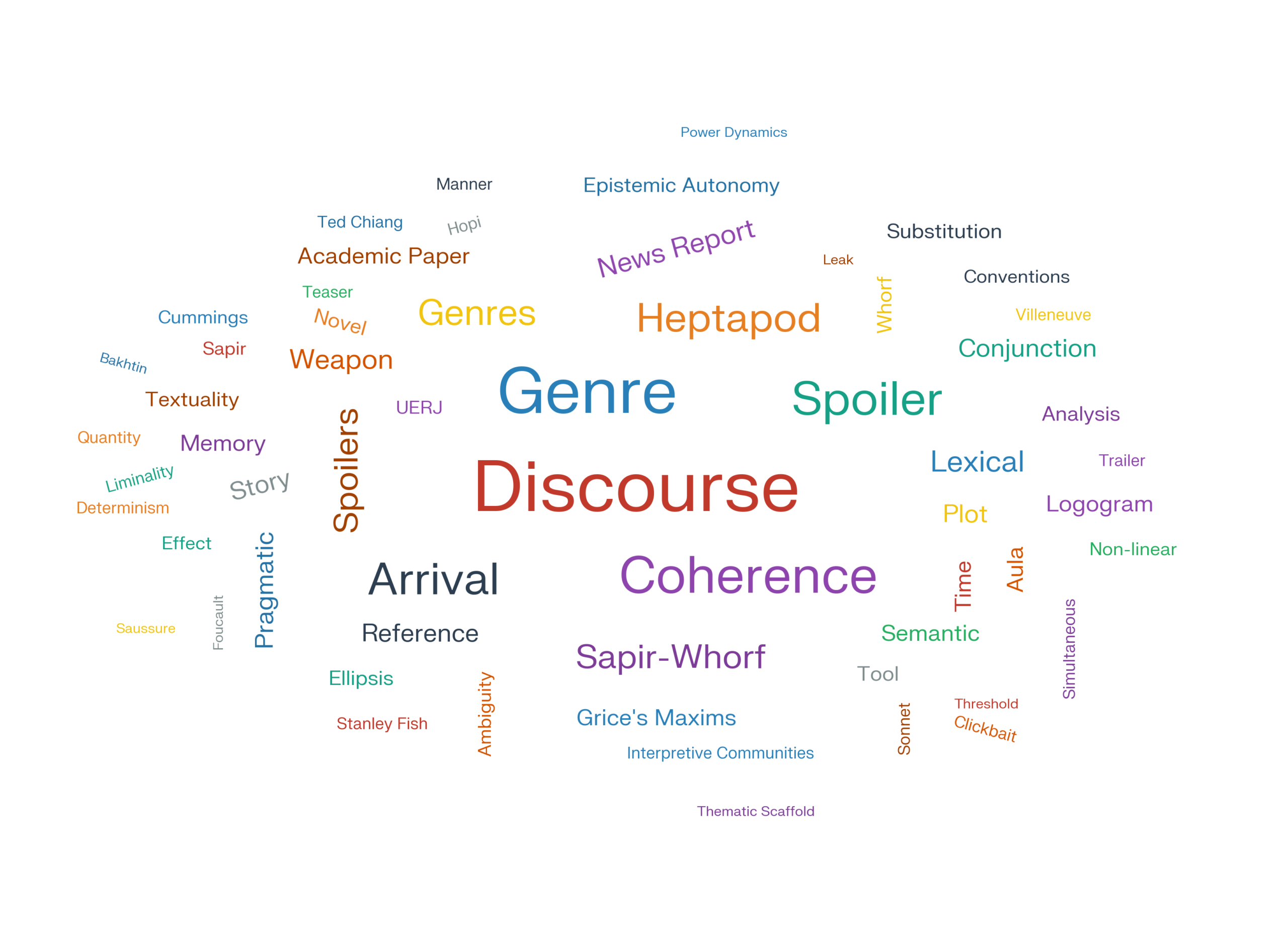
To begin our class today, do the following activity
read this one sentence out loud to the person next to you —
“She left without saying goodbye, and for the first time in years, he understood exactly why.”
Now invent the most convincing possible context that would make this sentence unmistakably belong to (a) a WhatsApp breakup message, and (b) the opening line of a literary short story, or invent your own context.
Same eleven words. Completely different genres. What changed — and where, exactly, did that change happen, if not in the sentence itself?
“Is Genre a Box, or a Contract?”
We have been doing genre since Aula 3 without ever naming it directly — comparing a lyric poem to a news report, rewriting Macbeth’s death as a spoiler versus a summary, noticing that Heptapod B breaks every rule the other genres follow. Aula 6 pauses to ask the question underneath all of that: what actually is a genre, and where does it live — in the words themselves, or in the relationship between writer and reader?
Genre Transformation Exercise
Rewrite this sentence from Arrival for three genres:
“There are days that define your story beyond your life.”
1. News report (use explicit reference, temporal conjunction):
_
2. Lyric poem (use repetition, parallelism, ellipsis):
_
_
3. Novel interior monologue (use substitution, ellipsis, deictic reference):
_
_
Reflection: Which cohesive devices changed? Which stayed stable? What does this reveal about genre expectations?
| Genre | Dominant Cohesive Devices | Coherence Expectations |
|---|---|---|
| Lyric poem | Lexical repetition, parallelism, phonological patterning | High tolerance for ambiguity; coherence often deferred or symbolic |
| News report | Conjunction (additive, temporal), reference (pronouns, demonstratives) | Immediate, linear coherence; low ambiguity tolerance |
| Novel (romance) | Lexical chains, substitution, ellipsis | Progressive coherence; reader constructs timeline and causality |
| Academic paper | Conjunction (causal, adversative), lexical reiteration | Explicit, hierarchical coherence; logical progression |
| Heptapod B | Non-linear, simultaneous logograms | No sequential syntax; coherence is immediate and holistic — if accessible at all |
Do you remember when we pondered about the meaning of the sentence t from the film’s central crisis, when the heptapods finally answer the mission’s key question. The logogram they produce could be translated as “OFFER WEAPON or OFFER TOOL.”
Is this a problem of translation, of discourse, or of ideology? The same signifier, in the heptapods’ language, covers both “weapon” and “tool” — the film’s entire conflict hinges on that discursive ambiguity.
Louise confronting the heptapods: communication begins not with grammar, but with the discursive act of showing, pointing, and negotiating meaning.
What Is Discourse?
- Saussure: discourse as parole — individual acts of language use, secondary to langue.
- Bakhtin/Voloshinov: every utterance is dialogic and socially situated; meaning emerges between speakers, not inside words.
- Foucault: discourses are systems of knowledge and power that define what can be said and thought.
Note how the film’s narration itself enacts non-linear discourse: what sounds like a flashback is revealed to be a flash-forward — discourse structure mirrors linguistic theory.
Guided Analysis
Heptapod Logograms with Translations
Key contrasts to draw out:
Debate
Now you are going to work in three groups, each defending a position with textual evidence:
- Group A — Strong determinism: Language determines thought. Evidence: Louise’s rewired cognition; Whorf’s claim that “we cut nature up, organize it into concepts, and ascribe significances as we do, largely because we are parties to an agreement… codified in the patterns of our language”.
- Group B — Weak relativism: Language only influences thought. Evidence: empirical findings, e.g., Russian speakers discriminate shades of blue faster because Russian lexicalizes two blues — influence, not imprisonment.
- Group C — Discourse as power (Foucault/Bakhtin): The film’s real conflict is not cognition but who controls interpretation. The mistranslation of “weapon/tool” nearly triggers global war — a problem of discursive framing, political context, and institutional power, not of grammar.
Debate motions:
- “This house believes that we cannot think what our language does not allow us to say.”
- “This house believes that the crisis in Arrival is caused by discourse, not by language.”
Closing Synthesis
Homework – write 5 lines answering: “Is language a weapon, a tool, or the world itself?” referencing to the classes here and to what we have studied up to now.
Attention: what is the genre of these lines you wrote for this homework?
Academic References
Halliday, M. A. K., & Hasan, R. (1976). Cohesion in English. Longman.
Hasan, R. (1984). Coherence and cohesive harmony. In J. Flood (Ed.), Understanding Reading Comprehension (pp. 181–219).
de Beaugrande, R., & Dressler, W. (1981). Introduction to Text Linguistics. Longman.
Koch, I. V. (2009). A coesão textual. Contexto.
Fox, B. (1987). Discourse Structure and Anaphora. Cambridge University Press.
A brief reflection about the class theme can be found here
Aula 7
Are we alone?
Task 1 – watch without taking notes. What do you think the film is about? Who seems to be hiding something, and who wants to reveal it?
Second viewing: now take notes. Do not try to understand every word. Instead, notice what helps you connect one image, voice, sound, or sentence to the next.

Ten years after Arrival gave us Heptapod B and the Sapir-Whorf hypothesis, Disclosure Day — Steven Spielberg’s 2026 sci-fi thriller — hands us almost the same premise wearing different clothes. A meteorologist, Margaret Fairchild (Emily Blunt), is contacted by extraterrestrials and begins to “speak languages she didn’t know,” seeing directly into people’s minds. A whistleblower, Daniel Kellner (Josh O’Connor), has stolen decades of suppressed government files and is determined to make them public, believing “what I stole, it belongs to 8 billion people — the whole world”. The villain, Noah Scanlon (Colin Firth), believes “society would collapse if people knew the truth” — Wardex’s entire ideology is that disclosure itself is the danger, not the aliens. If previously in Aula 2 we asked whether language is “a weapon, a tool, or the world itself,” Disclosure Day asks the same question about information: is disclosing a truth an act of liberation (Daniel and Margaret’s view) or an act of violence (Scanlon’s view)? This is Aula 4’s spoiler-ethics question — Grice’s Maxim of Quantity, epistemic autonomy, the “pragmatic breakdown of a spoiler” — scaled up from a movie plot to an entire planet’s worldview. The film’s climax is not a battle; it is a genre event
Task 2 – Create a short list with three things that help the trailer make sense as one story.
prepare your answer comlpleting the sentence: “The trailer feels connected because………… across the scenes.”
Task 3 — The Missing-Information Challenge
Write three things the trailer never fully explains. For example:
Who exactly is hiding the truth?
What is the threat?
What has been discovered?
Why might disclosure frighten people?
What will happen on “Disclosure Day”?
now answer: “Even though the trailer does not tell me everything, I think …. because….. .”
Task 4 — One-Sentence post
post in the padlet, individualy:
“One thing that holds the Disclosure Day trailer together is…. ; one thing I had to imagine or infer for myself is….. .”
Task V -What Holds This Trailer Together?
work in groups. Sort out 4-6 answers and based on them complete this table:
| The trailer gives us… | The viewer supplies… |
|---|
| The trailer gives us… | The viewer supplies… |
|---|---|
| Repeated words, images, voices, sounds, questions | Hypotheses, motives, chronology, consequences, genre expectations |
The first column describes cohesive resources. The second describes the audience’s work of building coherence.
Final words and final Task – In our class today, we worked with genre analysis, diferrent types of summary writing and cohesion and coherence altogheter. Hope you have enjoyed. One last reflection (and final task):
in Arrival, Louise learns a language that changes what she can perceive. In Disclosure Day, the world must decide whether it can make sense of a truth that has been withheld. Both rely their main themes to language and the interpretation of their realities. Now I ask a more technical version of that question: what makes a text (be it a trailer, broadcast, or whatever) hang together — and how much of that work belongs to the text, and how much belongs to us?
Aula 8
Is this a Summary? No, It Isn’t. Or is it?— Same Truth, Different Genre
In Aula 4, we learned that a summary and a spoiler can contain the same plot facts but produce completely different reactions. In Aula 6, we pushed that insight further: genre is not simply a box holding words; it is a contract between writer, reader, purpose, and situation. In Aula 7, Disclosure Day showed us that cohesion helps a text hang together, while coherence is the meaning an audience builds from textual ties, context, and genre expectations.
Today we test all three ideas through one deceptively simple question: when is a summary just a summary — and when does it become an abstract, a review, an executive brief, a narrative recap, a thematic interpretation, or a spoiler?
Because a summary does not merely make a text shorter. It makes choices: what to retain, what to omit, what order to follow, what audience to serve, and whether to evaluate. Those choices create a genre.
As we experienced last class, a trailer is already a highly compressed form of storytelling. Every student has summarised the same source, yet no two summaries will make the same choices. This is where genre begins: not in how short a text is, but in what the writer chooses to make visible for a particular reader and purpose. Read the texts below. Are they summaries? Is so, what are they highlighting?
I – Someone steals protected data described as “secrets” and says the public deserves the truth. A Kansas City weather broadcast is interrupted when its presenter begins speaking incomprehensibly. Other voices discuss a long concealment and the possibility of disclosure.
(basic summary)
II –
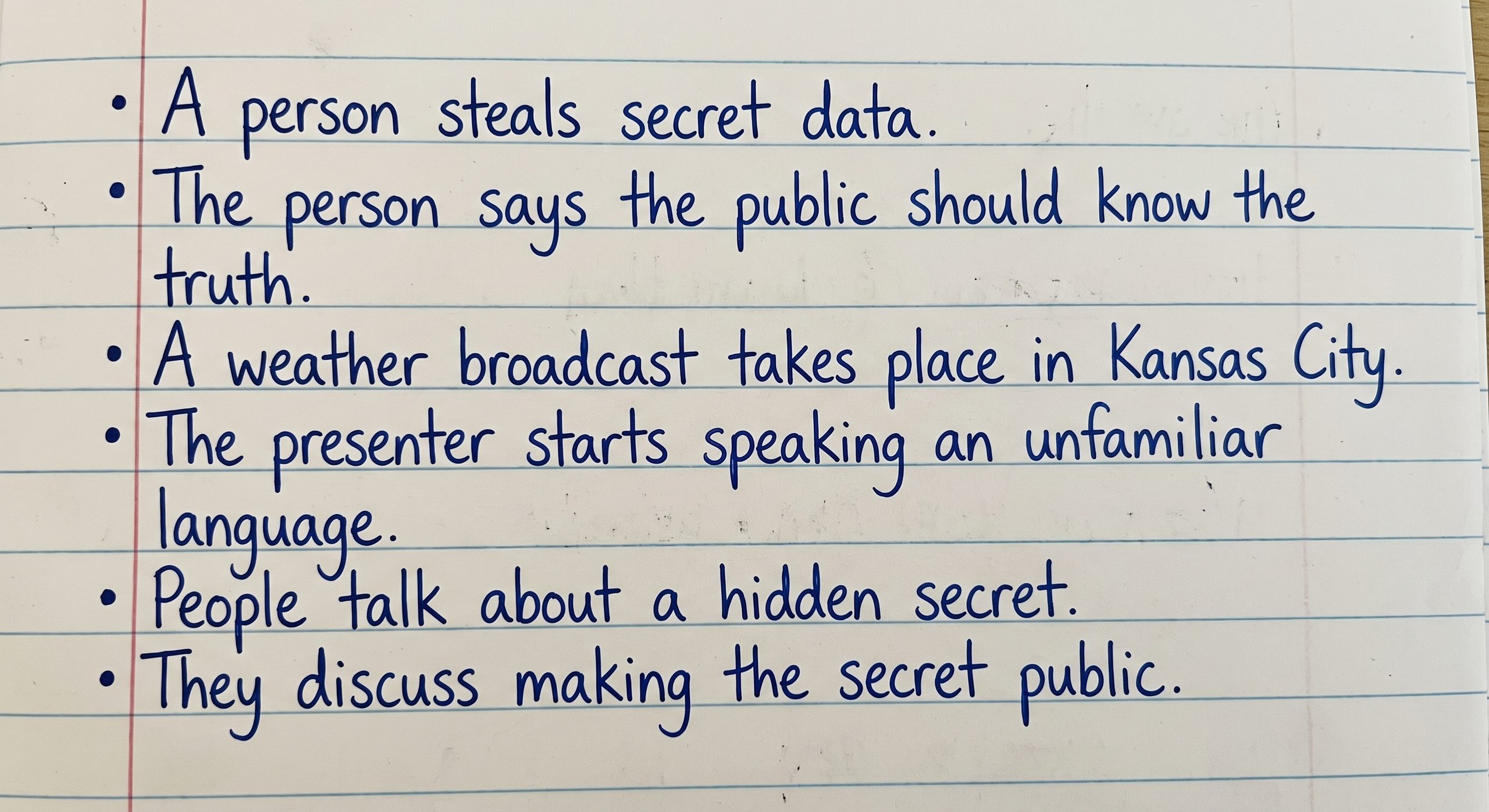
III – A person takes protected data and describes it as a collection of secrets that should belong to the public. At the same time, a weather presenter begins speaking in an unfamiliar language during a live Kansas City broadcast. As more voices refer to concealed information, the possibility of a public revelation becomes increasingly urgent.
(outline summary and narrative summary)
IV- The preview provides three main indications of its central conflict. First, protected data has been taken and is framed as information withheld from the public. Second, a live weather broadcast is disrupted by unfamiliar speech, linking the narrative to communication and unexplained phenomena. Third, multiple voices refer to concealment and possible disclosure, suggesting institutional conflict over access to knowledge. Taken together, these elements indicate that the narrative will investigate secrecy, communication, and competing claims about the public’s right to know.
(reseach findings)
V –

(executive summary)
VI – The preview effectively builds suspense through its limited disclosure of information. By combining stolen data, an interrupted weather broadcast, and unfamiliar speech, it creates a strong atmosphere of uncertainty without explaining the central mystery. Its focus on secrecy and public truth makes the premise intriguing, although viewers looking for clear plot information may find the presentation deliberately vague.
(evaluative summary/review)
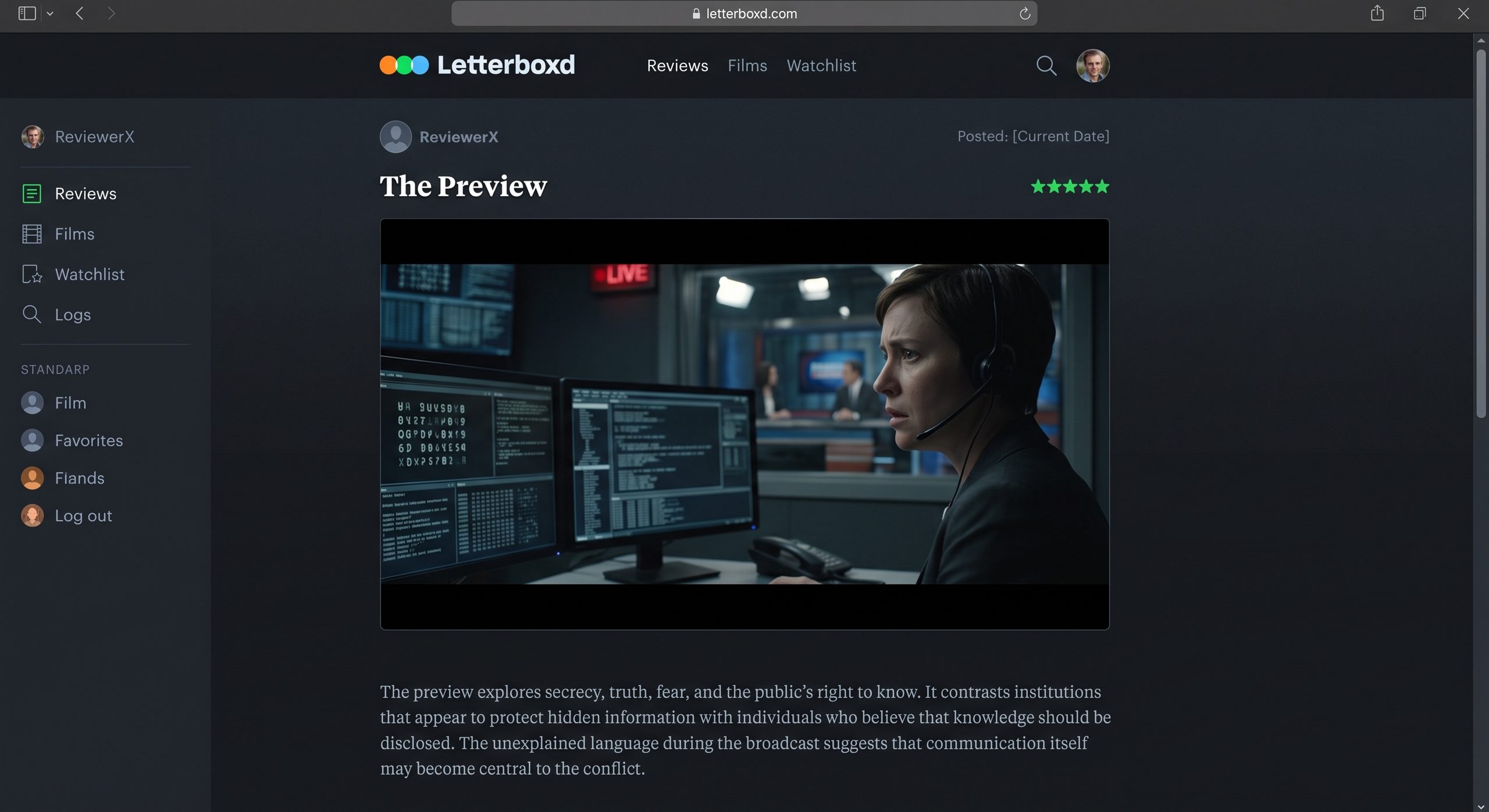
– VII
(thematic summary)
VIII – The preview presents a person who has taken protected data containing concealed information. During a Kansas City weather broadcast, the presenter unexpectedly begins speaking in an unfamiliar language. The scenes suggest that several people are connected to hidden knowledge and an approaching public disclosure.
(informative/descriptive summary)
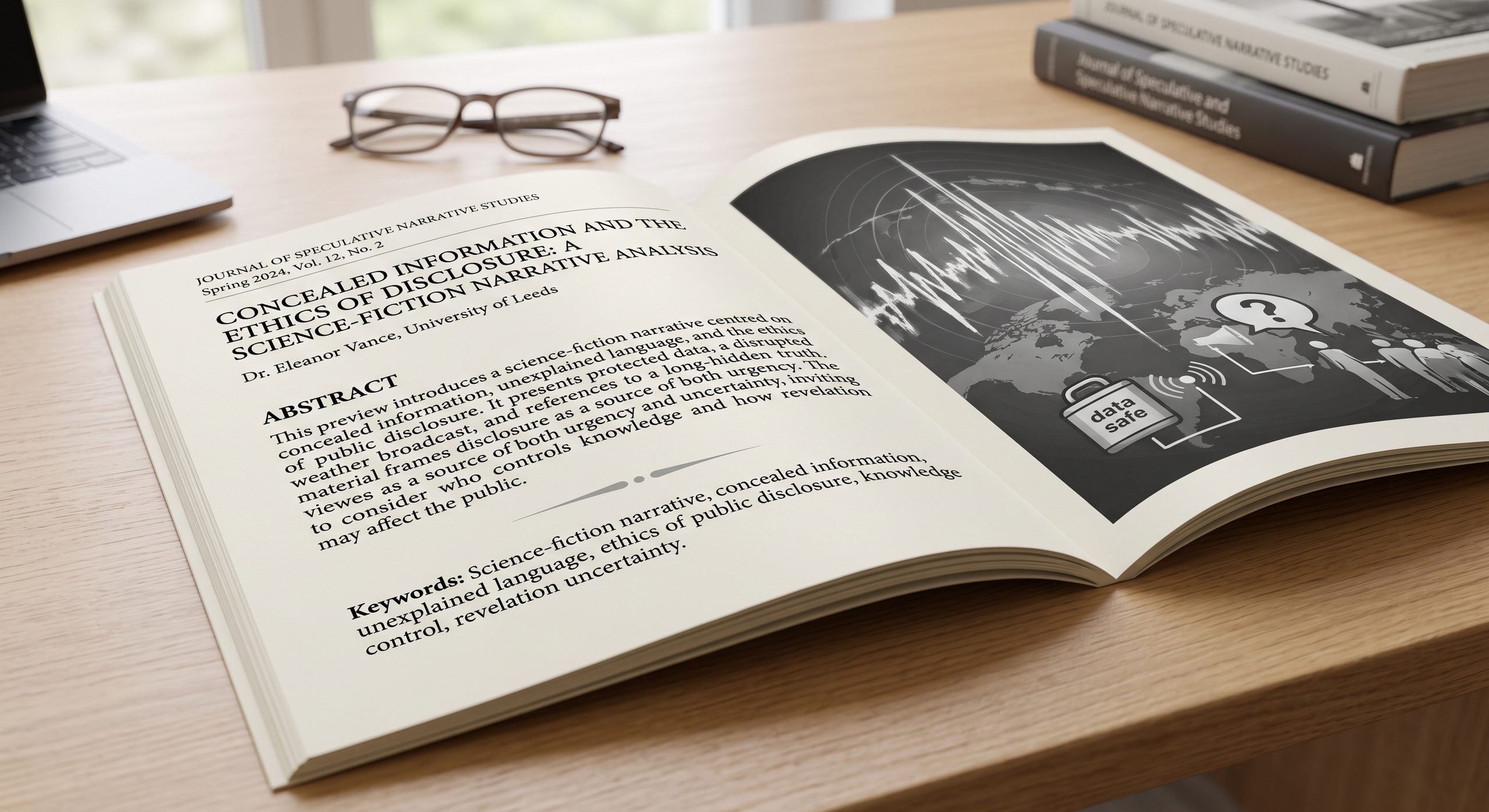
(abstract)
You have probably agreed that all are summaries. And that all summaries condense a longer source, retaining its central meaning and important points. But we must bear in mind that their form changes according to context, audience, and purpose. below is a “map”that aims to illustrate such differences. Please understand it as a working toolkit, not a rigid taxonomy:
| Summary genre | Main purpose | Typical content and organisation | Evaluation? | Cohesion/coherence priority |
| Informative / descriptive summary | Explain what a text says | Main point + key supporting information; concise, factual | No or minimal | Clear reference chains and logical sequencing |
| Narrative summary | Retell what happens | Plot progression, usually chronological | No | Temporal conjunctions; causal chain; controlled disclosure |
| Thematic summary | Explain what a text is about | Central ideas, patterns, conflicts; not necessarily plot order | Light interpretation, not a review | Lexical cohesion around key themes; conceptual coherence |
| Abstract | Help academic readers decide whether to read research | Purpose → method → principal findings → significance | Usually no personal judgement | Explicit move structure; highly compressed cohesion |
| Evaluative summary / review | Explain and assess a text | Basic content + judgement of validity, quality, usefulness, audience | Yes | Clear shift between summary and evaluation; evidence-based coherence |
| Executive summary | Enable time-poor decision-makers to act | Problem → key evidence/findings → implications/recommendation | Often, when a recommendation is needed | Hierarchical, front-loaded coherence; headings, key figures, action points |
| Research findings summary | Report a synthesis of evidence from several sources | Background → findings → implications / recommendation | May include recommendation | Source attribution and comparative lexical chains |
| Outline summary | Preserve the source’s skeleton | Original order and hierarchy of points | No | Parallel structure, numbering, headings |
Aula 9
Same Research, Different Abstracts — From Summary to Genre Analysis
In Aula 8, we discovered that a summary is never just a smaller copy of another text. The same Disclosure Day material became an informative summary, a narrative summary, a thematic summary, an evaluative review, an executive summary, a research-findings summary, and an outline. Each version selected different information, organised it differently, and made a different contract with its reader.
Today we take the next step: instead of asking only “What kind of summary is this?”, we ask “How can we prove that it belongs to this genre?”
This is the beginning of genre analysis.
Task I
Read the three short texts below. They all describe the same fictional study, but they do not belong to the same genre.
Shared source: fictional study information
A research team surveyed 240 undergraduate students after they watched a short science-fiction preview. Students who first received a thematic introduction to the preview identified its central conflict more often than students who received only plot facts. The researchers conclude that thematic framing can support inferential coherence during audiovisual viewing.
Text A
This study investigates whether thematic framing affects undergraduate viewers’ interpretation of a science-fiction preview. Two hundred and forty students watched the same audiovisual material after receiving either thematic framing or plot information. Students in the thematic-framing group identified the central conflict more frequently. The findings suggest that thematic framing supports inferential coherence in audiovisual interpretation.
Text B
Researchers surveyed 240 undergraduate students after they watched a science-fiction preview. One group received a thematic introduction, while another received plot information. The first group identified the central conflict more frequently. The study suggests that thematic preparation can help viewers understand audiovisual material.
Text C
A short study compares two ways of preparing students to watch a science-fiction preview. It presents participant information, viewing conditions, and a comparison of results. The text focuses on thematic framing, plot information, and students’ interpretation of a central conflict.
Your task
- Decide what genre each text most likely belongs to.
- Identify one reason for each decision. Do not just say “because it is short.”
- In a 40–60 word post on our padlet, complete this sentence:
“Text ___ is most likely a/an ___ because it begins by ___, then ___, and ends by ___.”
You are not expected to know the technical vocabulary yet. Bring your instinct and your evidence.
Task 2
What Made You Decide?
Compare, explain your choices,
The Genre Analysis Lens
As we noticed, genre analysis is not a hunt for one magical clue. It is an evidence-based explanation of several recurring choices.
| Question | What the analyst looks for | Example: academic abstract |
| 1. Situation | What recurring situation produces this text? | Researchers need to present a study rapidly to potential readers. |
| 2. Purpose | What must the text accomplish? | Help readers decide whether the full study is relevant. |
| 3. Audience / community | Who recognises and uses this text? | Researchers, students, editors, specialists. |
| 4. Moves and structure | What recurring rhetorical actions appear, and in what order? | Purpose → method → results → conclusion. |
| 5. Language and cohesion | What wording and cohesive patterns signal the genre? | “This study investigates”; past-tense methods; reporting verbs; lexical chains; logical connectors. |
the abstract is a useful first object because its moves are compressed and often visible. Research on abstract genre analysis commonly identifies a sequence such as Introduction / Purpose → Method → Product (results) → Conclusion, although not every abstract uses every move or follows precisely the same order. This variation matters: genre conventions are patterns and expectations, not prison walls.
So, here is the analysis of the texts
Text A is an informative research abstract: purpose → participants/material → result → implication.
Text B is an informative summary of a study: it gives central facts, but its move structure is less explicitly academic.
Text C is a descriptive summary: it announces topics and structure without reporting a full result or making a conclusion.
Task 1 (evaluation)
write a summary about the course up to now, as if you had to explain to the reader the natuee of the course and your experience. You decide the type and lenght of the summary (but no topics, please). It should include spome critical refletion as well. Pay attention to cohesion and coherence and language appropriateness
basic summary evaluative rubrics – course summary
| Criterion | What to evaluate | Score (0–10) |
|---|---|---|
| 1. Coverage of course content | Does the summary include the main topics studied so far, such as language and meaning, Arrival, linguistic relativity, cohesion and coherence, genre, and spoilers? | /10 |
| 2. Understanding of key concepts | Does the writer explain the central ideas accurately, rather than only listing terms or class activities? | /10 |
| 3. Use of relevant examples | Does the summary use appropriate examples from course materials or discussions, such as Arrival, Heptapod B, narrative voice, poems, news reports, or Macbeth? | /10 |
| 4. Organisation and coherence | Are the ideas organised in a logical order? Is the text easy to follow from beginning to end? | /10 |
| 5. Cohesion and language use | Does the text use cohesive devices effectively—for example, linking words, reference, repetition, and appropriate vocabulary? Are grammar and spelling clear enough to support understanding? | /10 |
| 6. Critical reflection | Does the writer explain why the course topics matter, especially in relation to language, interpretation, communication, reading, viewing, or spoilers? | /10 |
Total score: /60
Final score: /10
Calculate the final score by dividing the total by 6.
Aula 10
Abstract autopsy
In our last class we analysed the texts A, B and C and debated about them. We have focused in some importante elements when dealing with genre analysis: rhetorical moves, structure, language, and purpose.
I want to briefly highlight the ideia that I believe is new to us:
rethorical moves
A rhetorical move is a part of a text that performs a recognisable communicative job.
In an abstract, writers often make moves to introduce a topic, state a purpose, explain a method, report results, and show why the findings matter. A move may be one phrase, one sentence, or several sentences; what defines it is its function, not its size.
In the bibliography used for Aula 9 and 10, the main definition comes from John Swales:
A rhetorical move is “a discoursal or rhetorical unit that performs a coherent communicative function in a written or spoken discourse.”
— Swales, 2004, p. 228
In simpler terms, a rhetorical move is a recognisable part of a text that does a particular job for the writer and reader.
It is not defined by its length or grammar. A move can be:
- A clause: “This study investigates…”
- One sentence: “The results show that…”
- Several sentences or a whole paragraph
What matters is its function. Swales stresses that a move is a functional—not merely formal—unit: it may be realised by a clause at one end or several sentences at the other.
In an Academic Abstract
the abstracts we saw last class can be analysed through a sequence of rhetorical moves:
| Rhetorical move | Its communicative function | Example |
|---|---|---|
| Purpose | States what the study investigates | “This study investigates whether thematic framing affects interpretation.” |
| Method | Explains how the study was conducted | “Two hundred and forty students watched the same audiovisual material.” |
| Results/Product | Reports what the research found | “Students in the thematic-framing group identified the central conflict more frequently.” |
| Conclusion/Implication | Explains why the findings matter | “The findings suggest that thematic framing supports inferential coherence.” |
Five Questions for Genre Analysis
Which language, cohesion, and structure signal the genre?
What recurring situation produces the text?
What is the text’s purpose?
Who is its audience or discourse community?
What rhetorical moves appear, and in what order?
evaluation schedule here
Review
“Can a text be cohesive but fail to make sense to its intended reader?”
Task 1
Text analysis – read the texts below and analyse them based on your answer to the previous question.
A -I opened the window. The window overlooked a garden. The garden had a gate. The gate was painted blue. Blue is my favourite colour.
B -The presenter spoke an unfamiliar language during the weather report. Therefore, the stolen data must be authentic.
C – (a student has asked for a spoiler-free description of Macbeth) Macbeth hears a prophecy. It shapes his ambitions. Those ambitions lead to violence. That violence eventually ends when Macduff kills him.
While you were analysing, this is what you probably asked yourself:
| Question | What you examine |
|---|---|
| How are the parts linked? | Cohesion: repetition, reference, conjunctions, lexical chains |
| Why do these parts belong together for this reader and purpose? | Coherence: relevance, justified relationships, sufficient context, genre expectations |
Keep these questions in mind while examining cohesion and coherence
Activity 1
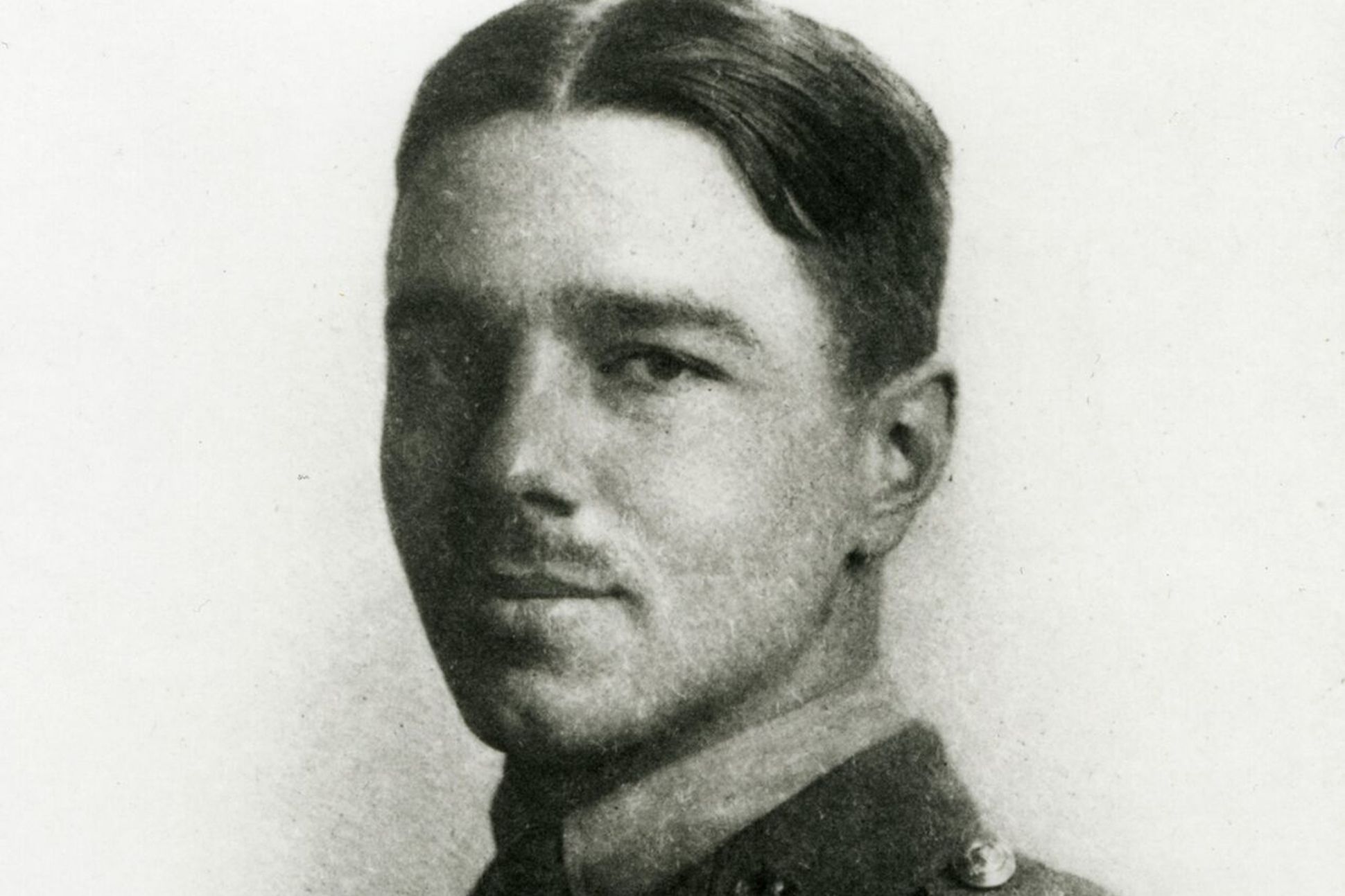
Dulce et Decorum Est
By Wilfred Owen
Bent double, like old beggars under sacks
Knock-kneed, coughing like hags, we cursed through sludge,
Till on the haunting flares we turned our backs,
And towards our distant rest began to trudge.
Men marched asleep. Many had lost their boots,
But limped on, blood-shod. All went lame; all blind;
Drunk with fatigue; deaf even to the hoots
Of gas-shells dropping softly behind.
Gas! GAS! Quick, boys!—An ecstasy of fumbling
Fitting the clumsy helmets just in time,
But someone still was yelling out and stumbling
And flound’ring like a man in fire or lime.—
Dim through the misty panes and thick green light,
As under a green sea, I saw him drowning.
In all my dreams before my helpless sight,
He plunges at me, guttering, choking, drowning.
If in some smothering dreams, you too could pace
Behind the wagon that we flung him in,
And watch the white eyes writhing in his face,
His hanging face, like a devil’s sick of sin;
If you could hear, at every jolt, the blood
Come gargling from the froth-corrupted lungs,
Obscene as cancer, bitter as the cud
Of vile, incurable sores on innocent tongues,—
My friend, you would not tell with such high zest
To children ardent for some desperate glory,
The old Lie: Dulce et decorum est
Pro patria mori.
Notes:
Latin phrase is from the Roman poet Horace: “It is sweet and fitting to die for one’s country.”
Copyright Credit: Wilfred Owen, “Dulce et Decorum Est” from Poems, ed. Siegfried Sassoon. New York: The Viking Press, 1921. Public domain.
1. First reading — Notice the turn
Work individually · 5 minutes
Read the poem once without looking for a “correct” interpretation try to find:
- a moment that surprises or unsettles you.
- where you think the poem changes direction or purpose.
- a reference or image you cannot yet explain.
At the beginning, who does “we” seem to include? Near the end, who might “you” address? Give one possibility and a reason.
Work in a group
Record examples from the poem; line references or short phrases are sufficient.
| Tracker | Two examples or line references | What connects, changes, or becomes clearer? |
| Reference: pronouns such as we, he, I, you | 1. __________________________ 2. __________________________ | __________________________________________ |
| Lexical cohesion: related words or images of fatigue, danger, bodily suffering, or memory | 1. __________________________ 2. __________________________ | __________________________________________ |
| Structure: exclamations, stanza breaks, the conditional if, or the return of the title’s claim | 1. __________________________ 2. __________________________ | __________________________________________ |
Discuss: What changes when the speaker moves from describing what happened to “we” to addressing “you”?
Pause and check: A pronoun, repeated image, or structural signal creates a link. Does that link alone tell you why the speaker is telling this story? Why or why not?
Continue with your group
Test this claim against the poem:
“The poem’s parts are linked by cohesive choices, but understanding the poem as a whole also depends on recognising whom it addresses and what belief it challenges.”
Now answer:
- Situation: What recurring human or social situation might call for this kind of poem?
- Purpose: What belief does the speaker ask readers to reconsider?
- Audience: Who might be included in the poem’s implied “you”? Could another audience read it differently?
- Context: The Latin title refers to the claim that dying for one’s country is sweet and fitting. How does knowing this affect your reading of the ending?
- Whole-text coherence: Choose one detail from the opening. How does its meaning change or become sharper when you reach the final address?
Opening detail or line reference: ___________________________________________
After reading the ending, I understand it as: _________________________________
Work with a partner
As we have seen, a rhetorical move is a part of a text that performs a recognisable communicative job. Give each section a verb-led label: for instance, establish a scene, challenge an expectation, or address a reader. Your labels need not match another pair’s labels if you can justify them.
| Part of the poem | What is presented? | What job does this part perform? | Evidence: brief phrase or line reference |
| Opening | Exhausted soldiers | _________________________ | _________________________ |
| Interruption | A gas attack | _________________________ | _________________________ |
| Recollection | The speaker’s continuing memory | _________________________ | _________________________ |
| Direct address and ending | A challenge to the reader | _________________________ | _________________________ |
Write individually then exchange with a partner
Write 35–45 words for each. Do not quote more than a brief phrase. Do not invent information.
What happens in the poem? Follow the selected events in order; avoid evaluating the poem.
What does the poem suggest about war, its representation, and the people who repeat heroic claims? Explain the idea rather than retelling every event.
Work individually · 3 minutes
How would your understanding of the poem change if it ended immediately after the gas attack, before the speaker addressed “you”? Distinguish between understanding what happened and understanding why the speaker tells us about it.