I – apresentação do curso
Prezados alunos e alunas,
Tudo bem?
Eu sou o Professor Marcello de Oliveira Pinto. Nesta apresentação, vou descrever um pouco o curso que você está iniciando.
Organização
A disciplina será ministrada de acordo com o calendário da faculdade. Ao longo dos semestres, faremos os ajustes necessários para que o curso possa se adaptar ao seu contexto.
Recursos didáticos
o material do curso está aqui
Está é a ementa do curso UERJ 10058 LINGUA INGLESA I
por aqui focaremos em Expressão escrita: o ensaio acadêmico.
Avaliação
Vocês serão avaliados da seguinte forma: Duas notas comporão sua média final (MF).
A primeira (N1) será composta pela soma das (auto)avaliações que vocês farão ao longo do curso, totalizando 10 pontos .
part (or all) of this first evaluatio will be the REFLEXIVE DIARY
A segunda (N2) será composta por uma avaliação holística da sua performance em sala feita por mim, totalizando também 10 pontos.
A média final será a soma das duas notas e para aprovação imediata é preciso que essa média seja igual ou maior que 7 pontos.
Importante: somente os alunos devidamente inscritos podem participar da disciplina. Caso você não esteja inscrito, por gentileza procurar a secretaria do seu curso. O docente não inclui ou faz a inscrição do aluno na turma.
Qualquer dúvida sobre as médias para aprovação, prova final, o que é o CR, calendário acadêmico e demais regulamentos, visitem o site da UERJ
Bom trabalho!
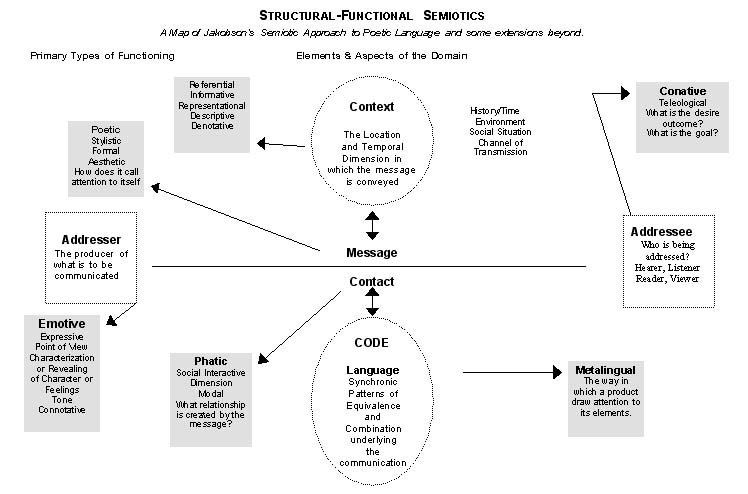
II – COMMUNICATION AND LANGUAGE
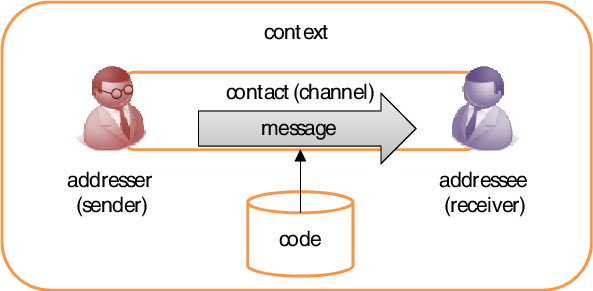
Jakobson’s communication model
Essay or article?
Primary Purpose
To contribute new, original knowledge to the field.
to demonstrate understanding and practice analysis.
Primary Audience
Instructor / Professor.
Peers / Experts in the discipline.
Basis of Argument
Original research and comprehensive literature review.
Course materials and assigned readings.
Publication Venue
Submitted as coursework; generally unpublished.
Published in a peer-reviewed academic journal.
check your answers and review our class discussion here
structure of the argumentative text

III – A LANGUAGE IS A LANGUAGE

Observe the dialogue below. Perform it with a partner:
In the middle of their lunch a woman asks another how she likes the hamburger she is eating, and receives the answer as the following:
[A] How do you like the hamburger?
[B} A hamburger is an hamburger
Speech Acts
Words as Tools
Think of language as a toolbox 🛠️. When we speak, we are not just describing the world; we are selecting a tool to perform a specific job. This idea, championed by philosopher J.L. Austin, suggests that every time we speak, we are performing an “act.” This act can be broken down into three distinct parts, much like using a tool from our toolbox.
Let’s say you pick up a hammer.
- The Locutionary Act (The Tool Itself): This is the literal meaning of the words you say—the physical tool in your hand. If you say, “The dog is in the garden,” the locutionary act is the simple, grammatical statement of fact about the dog’s location. It is the hammer itself, with its weight and shape.
- The Illocutionary Act (The Intended Job): This is the real magic. It’s the intended function of your words—the job you want the tool to do. Are you using the hammer to drive a nail, pull one out, or break a window? The same words, “The dog is in the garden,” could be:
- A warning (if the dog digs up flowers).
- A request (for someone to let the dog inside).
- An apology (if the dog was supposed to be kept indoors).
- A simple statement (informing a guest).
- The Perlocutionary Act (The Actual Result): This is the effect your words have on the listener—the result of the job you performed. Did the nail go in straight? Did your listener understand your warning and rush to save the flowers? Or did they just reply, “Yes, I can see him,” completely missing your point? The perlocutionary act is the actual outcome, which, as we all know from experience, doesn’t always match our illocutionary intention.
So, in essence, Speech Act Theory shows us that communication isn’t just about decoding sentences. It’s about recognising the tools being used, understanding the job the speaker is trying to do, and observing the results. It’s the difference between describing a hammer and actually using it to build something.
Now, observe the characteristics below. What do they represent?
| Interactivity | Synchronous, high interactivity, immediate feedback. | Asynchronous, low interactivity, delayed feedback. |
| Context | Shared context, relies on non-verbal cues (tone, gesture). | Context must be created within the text; no non-verbal cues. |
| Structure | Less structured, simple sentences, repetition, fillers. | Highly structured (paragraphs, etc.), complex sentences. |
| Lexical Density | Lower (more words needed to convey information). | Higher (more information packed into fewer words). |
| Formality | Tends to be more informal and personal. | Tends to be more formal and objective. |
| Production | Spontaneous, produced in real-time. | Planned, drafted, and edited. |
| Permanence | Ephemeral, transient, exists in the moment. | Permanent, creates a durable record. |
| Primary Function | Often relational, transactional, and social. | Often informational, legal, and historical. |
later, take a look here for a sum up of what has been discussed
and do not forget: communiction is to…
and to finish the class, our song!
To go further:
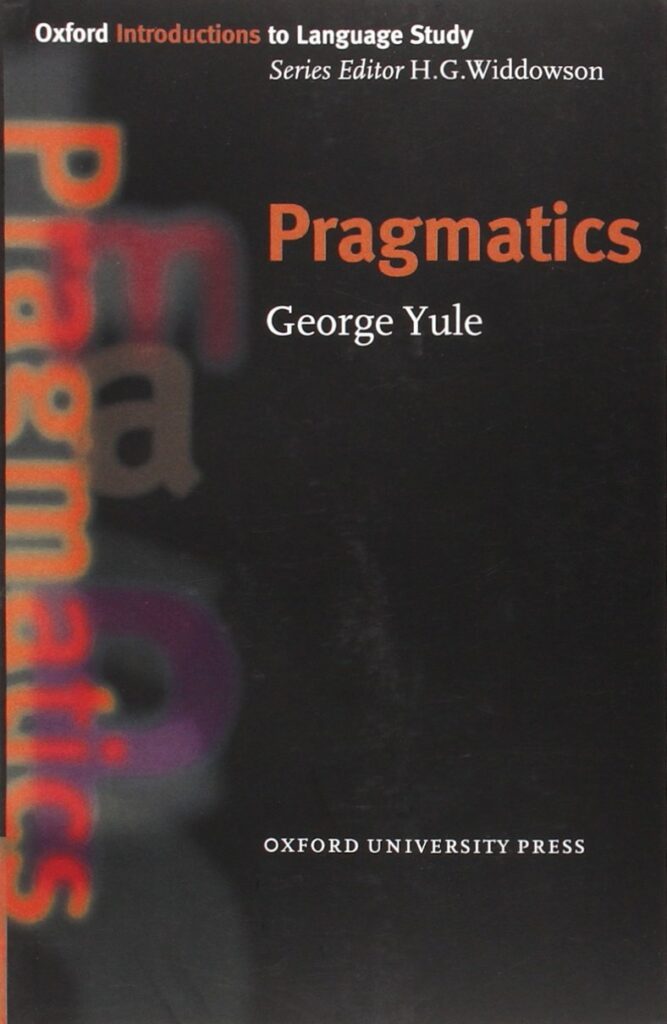
read it here and check this video if you want more
IV – More on diferences
Take a look at the picture below. In the coxtext of our discipline, what does it depict?

Understanding writing and speaking
Take a look at the words below. Are they about writing or about speaking? Divide them into two groups according to your view (remember last class? this is a review)
- Face to face
- reciprocity
- limited reciprocity
- Narrative-like
- Expository-like
- Action-oriented
- Idea-oriented
- Event-oriented
- Argument-oriented
- Story-oriented
- Explanatory
- Here and now
- Future and past
“So, if you want to really hurt me, talk badly about my language. Ethnic identity is twin skin to linguistic identity—I am my language. Until I can take pride in my language, I cannot take pride in myself. Until I can accept as legitimate Chicano Texas Spanish, Tex-Mex, and all the other languages I speak, I cannot accept the legitimacy of myself. Until I am free to write bilingually and to switch codes without having always to translate, while I still have to speak English or Spanish when I would rather speak Spanglish, and as long as I have to accommodate the English speakers rather than having them accommodate me, my tongue will be illegitimate. I will no longer be made to feel ashamed of existing. I will have my voice: Indian, Spanish, white. I will have my serpent’s tongue—my woman’s voice, my sexual voice, my poet’s voice. I will overcome the tradition of silence.”
THE ABSENT ONE
- “Absence” is a figure of the lover’s discourse… This figure is not symmetrical: the lover is the one who waits, the beloved is the one who is waited for. Or again: the beloved is the one who is assumed to be traveling, to be moving about, the lover is the sedentary one, the one who stays put, who waits. This is the oldest role distribution in the world (Penelope, Solveig).
- Historically, the discourse of absence is carried on by the Woman: Woman is sedentary, Man is the hunter, the traveler. Woman is faithful (she waits), man is fickle (he sails away, he cruises). It is Woman who gives shape to absence, elaborates its fiction… But the man who waits and suffers from waiting is miraculously feminized. A man is not feminized because he is inverted but because he is in love. (Myth and utopia: the origins have belonged, the future will belong to the subject in whom there is something of woman.)
And what about the other one, the one who is absent? The other is in a condition of perpetual departure, of journeying; the other is, by vocation, migratory, fugitive; the other does not wait, is never in the same place.
“And when I saw the limits of my own ability to verbalize my pregnant female and lactating queer post-adulthood—my new found, breathless adoration for the father of my child, my deep, shimmering, and incommunicable happiness, my desire to retreat into a domestic frontier of stupidity and joy—I remembered that my friend, the psychoanalyst, had told me that ‘the inexpressible is the only thing that is worthwhile expressing.’ I also remembered what a different psychoanalyst, D. W. Winnicott, had said about the ‘madness’ of maternal engrossment, about the mother’s state of heightened sensitivity that borders on illness. And I thought, That’s what I’ve got.”
Rubrics
Scoring Methodology and 10-Point Conversion
The scoring is a two-step process: (A) calculation of the weighted raw score, and (B) conversion of that raw score to the 10-point scale.
A. Raw Score Calculation (out of 65)
First, the raw score is calculated by multiplying the score (1-5) for each criterion by its weighting factor.
Formula:
(Score C1 * 5) + (Score C2 * 1) + (Score C3 * 1) + (Score C4 * 5) + (Score C5 * 1) = Total Score
- Maximum Possible Score: (5*5) + (5*1) + (5*1) + (5*5) + (5*1) = 65 points.
- Minimum Possible Score: (1*5) + (1*1) + (1*1) + (1*5) + (1*1) = 13 points.
B. Final Grade Conversion (out of 10)
Second, the Total Score (out of 65) is normalized to a 10-point scale using a standard ratio.
Formula:
Final Score (out of 10) = (Total Score / 65) * 10
Example Calculation
Let us assume a student receives the following scores on the 1-5 scale:
- C1 (Task): 4
- C2 (Grammar): 3
- C3 (Vocab): 4
- C4 (Coherence): 3
- C5 (Mechanics): 5
Step A (Raw Score):
(4 * 5) + (3 * 1) + (4 * 1) + (3 * 5) + (5 * 1)
= 20 + 3 + 4 + 15 + 5
= 47 (This is the Total Score out of 65)
Step B (Conversion):
(47 / 65) * 10
= 0.723 * 10
= 7.23 (This is the Final Score out of 10)
This weighting structure fundamentally alters the assessment’s focus. It places an emphasis on the student’s ability to fulfill the specific genre requirements (narrative-descriptive integration) and to structure their text in a logical, sophisticated manner (coherence and cohesion).
While the foundational linguistic elements—grammar (C2), vocabulary (C3), and mechanics (C5)—remain necessary components, their contribution to the final grade is proportionally diminished. This model aligns with a communicative, genre-based theory of assessment, prioritizing the text’s overall structural integrity and communicative success over sentence-level accuracy.
The 10-point conversion formula provides a final, normalized grade that is portable and easily understood by both the student and the institution.
Now correct your texts!
Prof Marcello
NOTAS (só as minhas e a situação final)
| nomes | situação final | MARCELLO OLIVEIRA: média |
|---|---|---|
| Elisa da Silva de Almeida | REPROVADO/A POR FALTA | 0 |
| Gabriel Temperini Pacobahyba | REPROVADO/A POR FALTA | 0 |
| Leticia Correa da Silva | APROVADO/A | 10 |
| Leticia de Alvarenga Alves | APROVADO/A | 10 |
| Lio Nunes Dantas e Silva | APROVADO/A | 9,5 |
| Livia de Jesus Valdivia dos Santos | APROVADO/A | 10 |
| Li Chang Alves Wu | APROVADO/A | 10 |
| Lucas Nogueira Costa Lesqueves | APROVADO/A | 7 |
| Maira Protasio Dias de Oliveira | APROVADO/A | 10 |
| Mariana Thomaz de Freitas Carneiro Lopes | APROVADO/A | 10 |
| Maria Carla Bezerra da Silva | APROVADO/A | 10 |
| Maria Clara Nascimento Barbosa Nunes | REPROVADO/A POR FALTA | 5 |
| Maria Clara Torres Homem de Oliveira | REPROVADO/A POR FALTA | 2 |
| Marina Correa e Castro Barros | APROVADO/A | 10 |
| Nicolas da Silveira Castro Alves | APROVADO/A | 8 |
| Pedro Renato Senrra de Souza | REPROVADO/A POR FALTA | 4 |
| Rafaela Alves Coelho | APROVADO/A | 9 |
| Thais Barbosa Lima | APROVADO/A | 9 |
| Thauane Monteiro de Moraes | APROVADO/A | 9 |
AVALIAÇÃO DO CURSO
PRA FINALIZAR, CONTO COM SUA AJUDA AVALIANDO O CURSO. OBRIGADO PELO ÓTIMO SEMESTRE E ATÉ BREVE!